
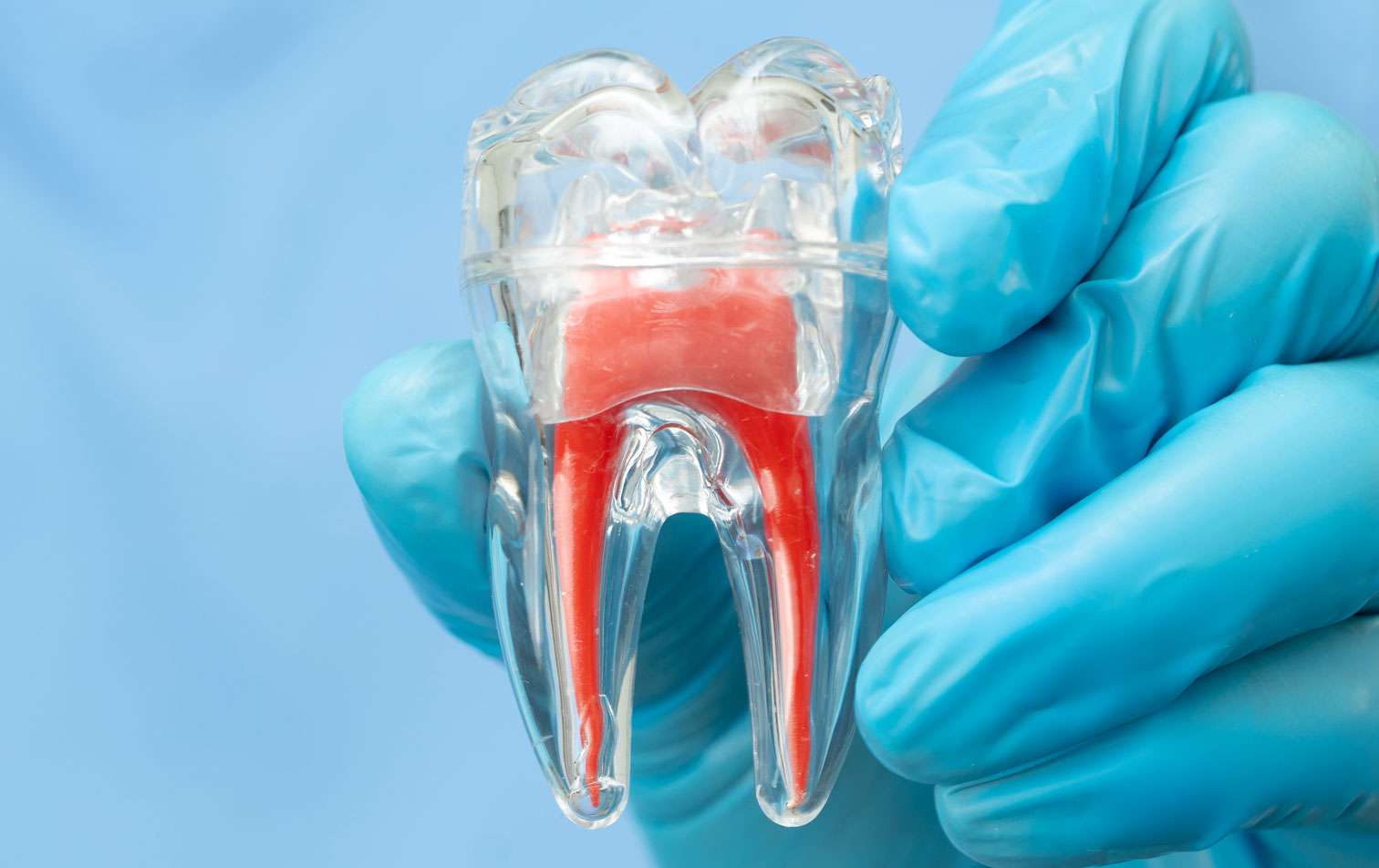
Why root canals fail — and how proper retreatment can still save your tooth
“Doctor, I already had that root canal done a year ago. They told me everything was fine. But the
pain never fully went away. And now it’s back — worse.” These words, with slight variations but
the same pain behind them, reach Dr. Tiapa more often than they should. Patients who already
sat in a dental chair, already paid, already believed their problem was solved — and return
months or years later with the same infection, or a worse one.
Why does a root canal fail? Is it the tooth, the patient, or the procedure? The answer, in most cases that arrive at DensCare in Escazu, Costa Rica, is always the same: the original treatment was not performed to the minimum standards of quality, biosafety and precision that this specialty demands.
The problem nobody told you about: suitcase endodontics
“In Costa Rica — and across much of Latin America — there is a practice informally known in dental circles as “”suitcase endodontics””. It refers to the endodontist or general dentist who travels from clinic to clinic, from office to office, carrying instruments in a bag or suitcase.
It sounds practical. The problem is what happens to those instruments between one clinic and the next. Endodontic instruments — files, irrigation tips, spreaders — are among the most difficult items to sterilize in all of dentistry. They are thin, have microcracks, recesses and complex geometries where microorganisms easily take hold. They require strict protocols: ultrasonic cleaning, individual packaging, autoclave at controlled temperature and pressure, and verified sterilization cycles.”
“Doctor, I already had that root canal done a year ago. They told me everything was fine. But the
pain never fully went away. And now it’s back — worse.” These words, with slight variations but
the same pain behind them, reach Dr. Tiapa more often than they should. Patients who already
sat in a dental chair, already paid, already believed their problem was solved — and return
months or years later with the same infection, or a worse one.
“This is not speculation: the scientific literature documents recurring and persistent dental infections directly linked to cross-contamination from inadequately sterilized instruments. A root canal treatment that starts with a contaminated instrument is condemned to fail from day one, no matter how well everything else is done.”
Biosafety in endodontics: what your dental office must guarantee you
Biosafety is the set of rules, protocols and physical barriers designed to protect the patient — and the professional — from the transmission of microorganisms during a clinical procedure. In endodontics, where work is done directly inside the tooth’s root canal, biosafety is not optional: it is the difference between a treatment that heals and one that creates a new infection.
At DensCare, the biosafety protocol for every endodontic procedure includes:
- Class B autoclave sterilization for all instruments, with documented cycles verified by biological indicators.
- Endodontic files used once or with strict use-count control per protocol — never recycled without verification.
- Individual packaging of each instrument with airtight sealing until the moment of use.
- Full physical barriers: sterile operative field, rubber dam, eye protection, gloves, surgical gown and cap.
- Work surfaces covered with disposable barriers changed between every patient.
- Root canal irrigation with sodium hypochlorite and EDTA at verified concentrations, prepared in-office under controlled conditions.
“Doctor, I already had that root canal done a year ago. They told me everything was fine. But the
pain never fully went away. And now it’s back — worse.” These words, with slight variations but
the same pain behind them, reach Dr. Tiapa more often than they should. Patients who already
sat in a dental chair, already paid, already believed their problem was solved — and return
months or years later with the same infection, or a worse one.
Case 1 — Three canals where nobody expected to find them
“I had the treatment done and from day one something wasn’t right. There was a discomfort that
never fully went away. They told me it was normal, that the tooth was adjusting. A year went by”
“and it was still the same.”
Under the operating microscope at DensCare, the cause was immediate: the molar had three canals in the distal root — an anatomical variation only identifiable with proper magnification. The original treatment had addressed only one of the three. The other two remained untouched, with active necrotic pulp tissue and bacteria proliferating freely.
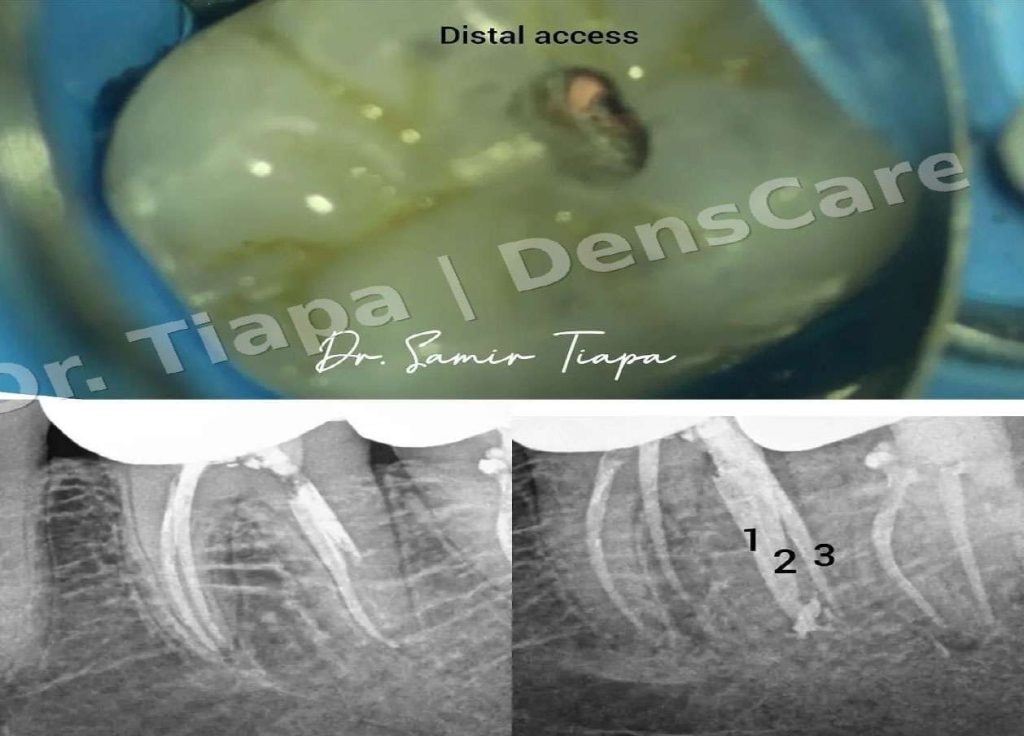
Case 1 — Dr. Tiapa, DensCare, Costa Rica. Microscope view of distal access (top): complex anatomy with three canal entrances visible only under magnification. Pre/post retreatment X-rays (bottom): canals 1, 2 and 3 fully treated.
Cause of failure: complex anatomy undetected due to lack of operating microscope. Two”
“untreated canals = persistent infection = constant discomfort.
Case 2 — The invisible canal that destroyed the bone
“After the root canal I was never comfortable. The first months I put up with it thinking it was
normal. Then came one antibiotic after another. Until my face swelled up and I had to go to the”
“emergency room.”
The CBCT revealed an extensive periapical lesion: the bone around the root had been progressively destroyed by a dental infection that was never eliminated. The cause was a canal left undetected due to lack of an operating microscope. The infected pulp tissue remained active inside the tooth, releasing bacteria into the bone for months, generating persistent discomfort that was repeatedly treated with antibiotics — without ever attacking the real cause.
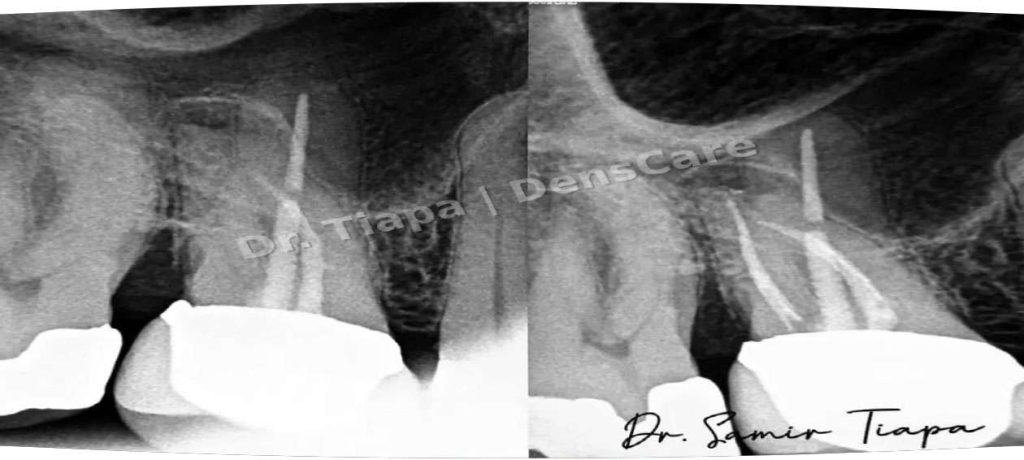
Case 2 — Dr. Tiapa, DensCare, Costa Rica. Periapical X-rays pre (left) and post (right) retreatment. Extensive periapical lesion from untreated canal in previous procedure without microscope. Complete resolution of dental infection and bone recovery after retreatment with microscope and strict biosafety protocols.
Cause of failure: canal undetected due to lack of microscope. Active infected tissue
destroyed the surrounding bone. Without a microscope, certain canals are simply invisible.
Case 3 — The contamination that travelled in a bag
“The dentist came to the clinic every two weeks. He brought his little bag with everything. He did the treatment in two appointments. At first it seemed fine, but the discomfort never left. It got
worse over time. When I got to Dr. Tiapa and saw the images, I understood the problem had”
“been there from day one.”
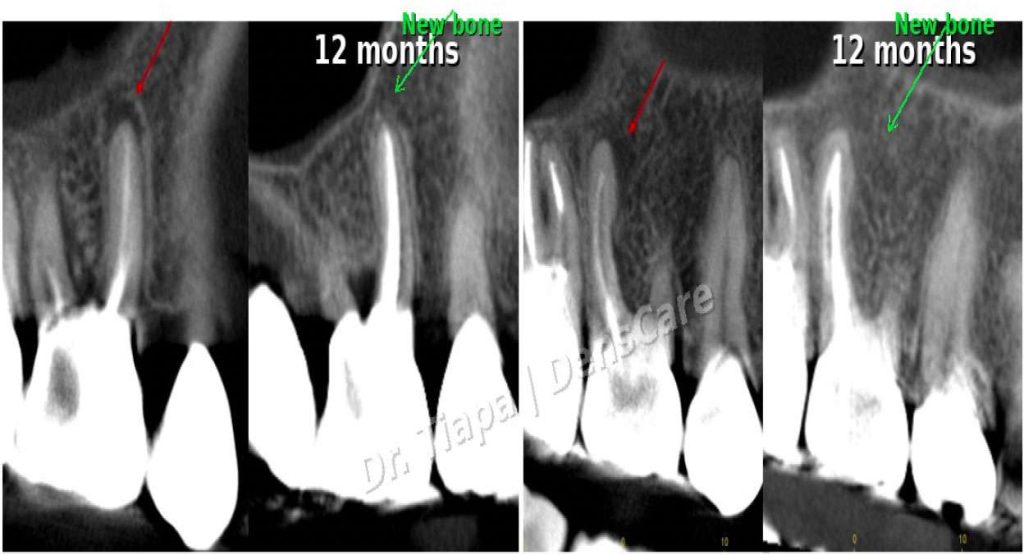
This is a textbook case of suitcase endodontics. CBCT images showed an active periapical lesion with considerable bone destruction. The most probable cause: cross-contaminated instruments travelling between offices, with no sterilization guarantee, seeding bacteria inside the canal system from the very first session. A root canal that starts with contamination cannot heal — it can only worsen.
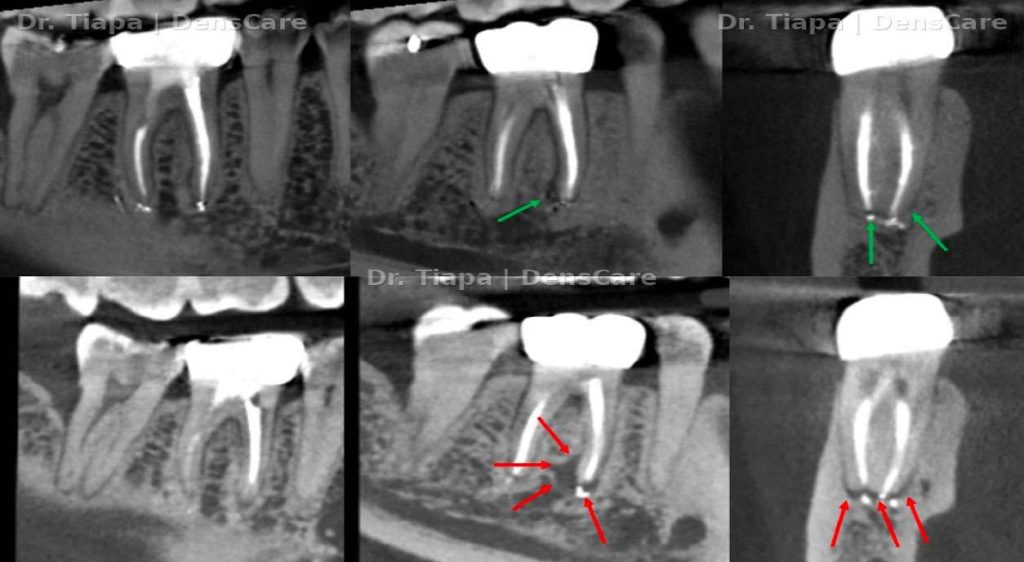
Case 3 — Dr. Tiapa, DensCare, Costa Rica. Multi-view CBCT. Red arrows: active periapical lesion from cross-contamination (suitcase endodontics). Green arrows: complete lesion resolution and bone healing after retreatment with strict biosafety protocols at DensCare.
Cause of failure: cross-contamination from inadequately sterilized instruments. Suitcase”
“endodontics = a real risk to the patient from the very first session.
Case 4 — The bag arrived, the infection stayed
“For months I had this discomfort that was not exactly pain, but was not right either. My dentist
kept telling me the treatment was perfect, that everything looked normal. When I got to”
“DensCare, the imaging told a very different story.”
The X-rays in this case are the portrait of suitcase endodontics. The periapical lesion established itself early, fed by a dental infection seeded by instruments without sterilization guarantees. The patient felt constant discomfort because his body was actively fighting bacteria introduced by the very instrument used in the treatment. Retreatment at DensCare, under strict biosafety protocols and in an impeccable dental office, resolved the infection completely.
Case 4 — Dr. Tiapa, DensCare, Costa Rica. Pre (left) and post (right) retreatment X-rays. Periapical lesion from
cross-contamination (suitcase endodontics). 12-month follow-up: bone healing confirmed after retreatment with strict biosafety at DensCare.
Cause of failure: cross-contamination from suitcase endodontics. Instruments without
verified sterilization seeded the infection from the start. Persistent postoperative discomfort. Complete resolution at DensCare.
Case 5 — The canal nobody found without a microscope
“They told me the treatment had gone well. But I kept feeling that pressure that would not go
away. Nobody could explain why. Until Dr. Tiapa’s microscope found what everyone else had missed.”
The X-rays showed an active periapical lesion with progressive bone loss, originating from a canal undetected due to lack of an operating microscope. The anatomical variation was subtle — invisible without magnification. The infected pulp tissue remaining in that overlooked canal continued destroying the surrounding bone while the patient endured a discomfort that nobody could explain. Under the operating microscope at DensCare, the canal was located, disinfected and sealed. Postoperative images confirm complete resolution.
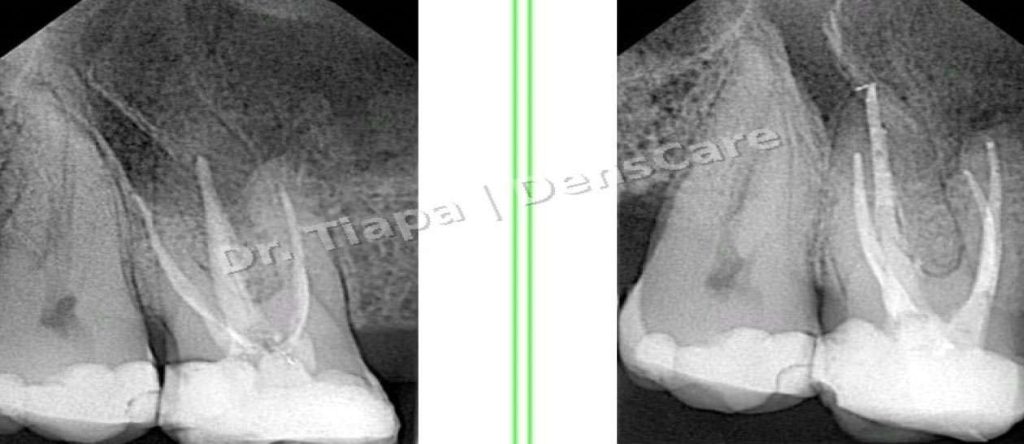
Case 5 — Dr. Tiapa, DensCare, Costa Rica. Pre (left) and post (right) retreatment X-rays. Canal undetected in previous treatment without microscope — active periapical lesion. Post retreatment with microscope at DensCare: complete obturation and lesion resolution.
Cause of failure: canal undetected due to lack of operating microscope. Five cases, one
message: without a microscope and strict biosafety, failure is not a possibility — it is a probability.
What you should know before your next root canal
The five cases you just read have one thing in common: every patient endured months of discomfort, uncertainty and unnecessary expense because of treatments that did not meet the basic standards of quality and biosafety. None of them had a tooth “beyond saving”. All of them had a previous treatment that failed — and a proper retreatment that restored their health.
As an endodontist in Escazu, Dr. Tiapa sees these cases regularly at DensCare. And each one reinforces the same conviction: endodontics performed correctly, with proper technology, strict biosafety protocols and an impeccable dental office, achieves success rates above 90% according to current scientific literature. The endodontics that fails is not the specialty — it is the lack of conditions to practice it properly.
Before your root canal, you have the right to ask: Do you always work in the same office with your own equipment? How do you document your sterilization cycles? Do you use an operating microscope? Do you have CBCT imaging available for diagnosis? If the answer
to any of these questions is vague or uncomfortable, seek a second opinion.
At DensCare, Torre Medica 2, 2nd Floor, Office 203, Hospital CIMA Escazu, Costa Rica, every treatment is performed in a controlled clinical environment, with dedicated instruments, documented sterilization, an operating microscope and CBCT imaging. Dr. Tiapa does not carry his instruments in a bag. They are where they belong: in an office prepared to use them correctly.


