
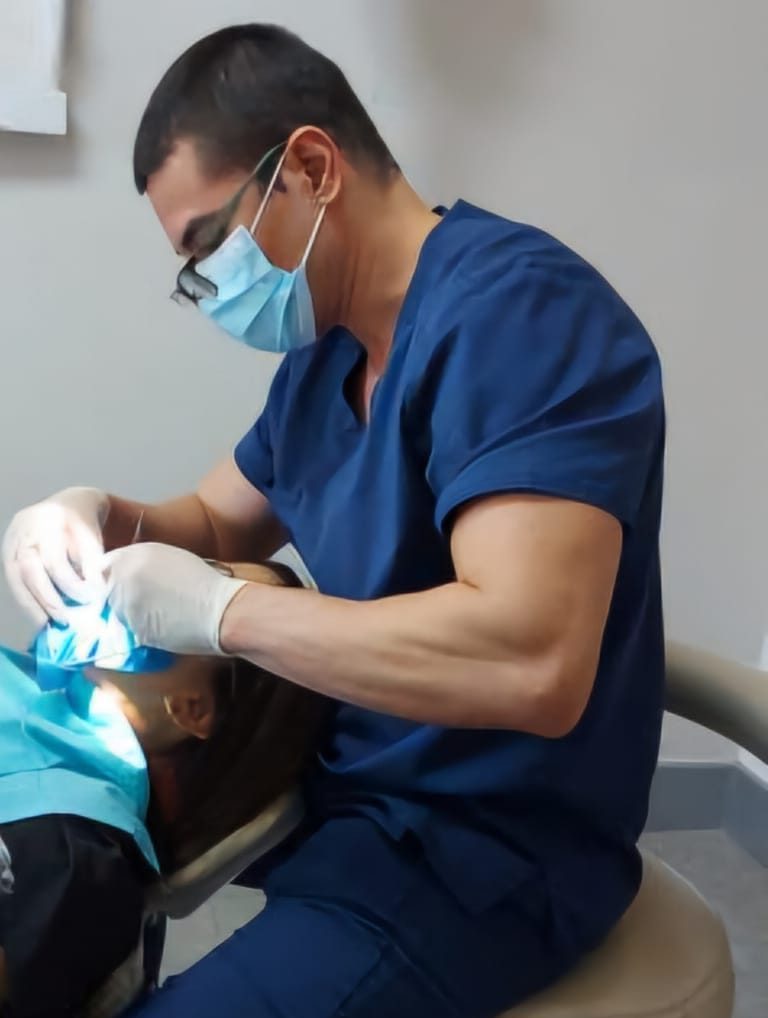
Endodontics isn't simply "treating the nerve." It's diagnosing with precision, working in microscopic spaces, and restoring a patient's quality of life. That takes training, technology, and — above all — vocation.
When someone walks into DensCare with their face tense from pain, with the look of someone who hasn’t slept well in days, Dr. Samir Tiapa doesn’t just see a patient. He also sees a younger version of himself.
Because Dr. Tiapa knows what that pain feels like. He lived it firsthand.
This isn’t a marketing line or a clever phrase. It is, quite literally, the origin of everything DensCare is today: a specialized endodontics practice where every clinical decision, every protocol, and every gesture toward the patient comes from a deep understanding of what it means to have dental pain and not yet know that there is a way out.
A trauma that changed everything
Growing up in Caracas, Venezuela, was a rich experience in many ways. But among those childhood memories, one left a deep mark on Dr. Tiapa’s life: a dental trauma he suffered at a young age that caused him intense, hard-to-forget pain.
“That pain stayed with me,” he recalls. “And from that moment on, something changed in me. I decided that if I could help someone else avoid feeling what I felt, that was what I wanted to do with my life.”
It wasn’t a passing pain or a scare without consequences. It was an experience that, for days, left him feeling vulnerable and frightened, without fully understanding what was happening to him or why. That feeling of helplessness —of having no control over your own body, of depending entirely on an adult and a professional for the pain to stop— is something many children experience and forget over time. For Dr. Tiapa, instead, it became a kind of emotional scar that, far from holding him back, became his driving force.
That experience wasn’t an obstacle — it became his compass. It led him to study Dentistry in Venezuela, where he graduated between 2001 and 2006, and later guided him directly toward the specialty that addresses dental pain most closely: Endodontics.
During his years of university training, Dr. Tiapa remembers feeling a particular pull toward clinical subjects where pain management was central: anesthesia, emergency care, differential diagnosis. While many of his classmates leaned toward more aesthetic or higher-visibility specialties, he felt drawn to the opposite: to the patient who arrives without an appointment, face swollen, eyes watering, seeking immediate relief.
The specialty of pain with purpose
In 2008, Dr. Tiapa completed his specialization in Endodontics in Venezuela, training in the diagnosis and treatment of conditions affecting the inside of the tooth — the root canals, the dental pulp, and the tissue surrounding the root. A specialty that, practiced well, turns fear into relief and saves teeth that seemed beyond hope.
During years of practice in Venezuela, Dr. Tiapa refined his technique by treating increasingly complex cases: retreatments, severe calcifications, periapical surgeries. Every patient reminded him why he had chosen this path.
It was during those years of intensive practice that one of the convictions that defines his approach today began to take shape: that successful endodontics depends less on the “luck” of the case and more on the discipline of the process. Complete isolation of the operative field, proper magnification, careful instrumentation, protocolized irrigation. Small details that, added together, make the difference between a tooth saved and one lost.
It was also during this period that he began to notice a pattern that troubled him: patients arriving as referrals from other practices, after having passed through several different hands during a single treatment. One general dentist would start the procedure, another would continue it, a third would finish it—and somewhere along that chain, something would get lost. Not necessarily out of bad intent, but simply because of the logic of fragmentation: when no one is fully responsible for a case from start to finish, it becomes easier for details to be diluted.
That observation stayed with him. Years later, it would become one of the founding pillars of DensCare.
Costa Rica: a new beginning
In 2016, Dr. Tiapa made a decision that would change the course of his career: moving to Costa Rica. He saw an opportunity in the country to build something of his own — a practice where patient care wouldn’t be diluted across multiple hands, where every case would receive the full dedication of a single specialist, from start to finish.
The decision wasn’t an easy one. Leaving behind an already established practice, a network of colleagues and referral sources, and a familiar country, to start from scratch in a new environment, meant taking on significant risk. But Dr. Tiapa understood that Costa Rica offered something valuable: a robust private healthcare system, growing international interest in dental tourism, and a medical ecosystem —particularly around Hospital CIMA Escazu— that valued specialization and quality over volume.
That’s how DensCare was born, located in Torre Medica 2, inside Hospital CIMA Escazu. A space designed for specialized endodontics, equipped with an operating microscope and a rigorous clinical protocol, where every detail — from the first consultation to the final follow-up — is personally overseen by Dr. Tiapa.
Building the practice from scratch meant making decisions that went far beyond office design. It meant deciding, for instance, that the operating microscope would not be an occasional luxury but the standard for absolutely every procedure. It meant building a biosafety and instrument-handling protocol that met the highest international standards. And above all, it meant defining from day one what kind of relationship he wanted to have with every patient who walked through the door.
From Escazu, DensCare has welcomed patients from San Jose, Santa Ana, Alajuela, and also from the United States, drawn by the combination of clinical experience, technology, and human closeness. Many of those international patients arrive as part of medical tourism trips, combining their endodontic treatment with other health-related matters or even a vacation; others are foreign residents who have made Costa Rica their home and are looking for a trusted specialist nearby who speaks their language and understands their particular needs as patients coming from a different healthcare system.
The first months of DensCare were not easy. Building a clinical reputation from the ground up, in a new market, without the referral network that years of practice in another country had generated, required patience and persistence. Dr. Tiapa remembers those early days as a constant learning process: understanding the particularities of the Costa Rican healthcare system, building trust-based relationships with general dentists in the area, and proving, case after case, that the quality of the work spoke for itself.
Over time, that initial bet paid off. Referrals from other professionals began arriving consistently, satisfied patients shared their experience with family and friends, and little by little DensCare became a recognized option for complex endodontic cases in the western Greater Metropolitan Area.
A promise that is never delegated
There’s something that sets Dr. Tiapa apart from many other practices: he personally treats, guides, and follows up on every procedure performed. There’s no support staff filling in, no treatments passed from hand to hand. The doctor who greets you at the first consultation is the same one who treats you, the same one who reviews your final x-ray, the same one who answers your questions at the follow-up visit.
"When a patient arrives in pain, they don't need technical explanations — they need to feel that someone truly understands what they're going through, and that this person will be there every step of the way,"
Dr. Tiapa
This philosophy isn’t just a marketing promise —it’s a concrete operational decision that shapes how the entire practice is organized. For example, DensCare’s schedules are specifically designed to give Dr. Tiapa enough time with each patient, without the pressure of rushing through an excessive number of people each day. In practice, this means fewer patients per day than a high-volume clinic, but considerably deeper and more personalized care for each one of them.
That philosophy of personalized care, combined with the consistent use of the operating microscope in every procedure, has made DensCare a reference point for complex endodontic cases, retreatments, and periapical microsurgery in Costa Rica.
The operating microscope, in particular, deserves special mention. It’s not just a magnification tool: in daily practice, it’s the difference between guessing and knowing. It allows for identifying accessory canals that would be invisible to the naked eye, detecting early-stage root fractures, and working with a precision that drastically reduces the margin of error in procedures that, by their very nature, take place in spaces measured in fractions of a millimeter.
Dr. Tiapa often explains it in simple terms to his patients: “Imagine trying to fix the mechanism of a fine watch without a magnifying glass. Technically possible, but the chances of making a mistake increase enormously. The microscope gives us the clarity that the human eye, on its own, simply cannot offer.”
What it means to treat from start to finish
To really understand what this promise of continuity means, it helps to describe what a typical case at DensCare looks like in practice. It all begins with an initial consultation, where Dr. Tiapa personally evaluates the case: reviews the clinical history, takes or requests the necessary x-rays, and speaks directly with the patient about their symptoms, fears, and expectations.
From that first encounter onward, it is Dr. Tiapa himself who designs the treatment plan, explains the available options, and —if the patient decides to proceed— who also performs the procedure under the operating microscope. There is no imperfect handoff of information between different professionals, no risk that some relevant clinical detail gets lost in a case transfer.
Once treatment is complete, postoperative follow-up also remains in his hands. This includes short-term check-ins to verify that healing is progressing as expected, as well as medium- and long-term reviews—generally between six months and a year— where the success of the treatment is confirmed radiographically.
This continuity has a benefit that goes beyond the purely clinical: it builds trust. Patients know exactly who to turn to if any question or discomfort arises after the procedure, without having to repeat their clinical history to a different professional every time they call the practice.
There is also a less visible, but equally important, component: clinical responsibility concentrated in a single person demands a different level of rigor. When a specialist knows that he —and no one else— will face the consequences of any decision made during treatment, the discipline applied to every step of the procedure changes. There is no room to delegate responsibility or to dilute mistakes across several professionals. That personal standard, sustained over years of practice, is part of what has built DensCare’s reputation among general dentists who refer complex cases.
In fact, a significant portion of the patients who arrive at DensCare do not do so on their own initiative,
but through direct referral from other general dentists who, upon encountering a case beyond their scope —a severe calcification, an atypical root anatomy, a highly complex retreatment— prefer to send their patient
to a specialist they know will take full ownership of the case, without fragmentation or further referrals down the line.
A typical day under the microscope
To grasp the real scope of this philosophy, it helps to picture how a normal workday unfolds at DensCare. Dr. Tiapa’s day begins early, reviewing the list of scheduled patients and going over, case by case, the previous x-rays and clinical notes. This isn’t a superficial review: it’s the same attention to detail he will later apply, live, during each procedure.
Each appointment is scheduled with ample time, avoiding the “fast turnover” logic that characterizes many high-volume practices. This allows him, for example, to spend extra minutes explaining to an anxious patient exactly what they will feel during anesthesia, or to calmly review an x-ray together with the person sitting in the chair, pointing on the screen to exactly where the problem is and how it will be resolved.
During the procedure itself, the operating microscope remains on from the very first minute. It isn’t an instrument used “when the case calls for it” —it is simply the standard way of working at DensCare, whether the case is straightforward or extraordinarily complex. That consistency removes any subjective judgment call about when to use magnification and when not to: it is always used.
Between patients, Dr. Tiapa takes detailed notes on each case —not only the technical procedure performed, but also observations about how the patient felt, what concerns they expressed, and what aspects of follow-up should be prioritized at the next visit. That careful documentation is, in itself, an extension of the promise of continuity: it allows a case to be picked back up immediately, even weeks or months later.
Patients who travel far
One of the most enriching aspects of working at DensCare has been the opportunity to care for a truly diverse community of patients. Costa Rica, and particularly the Escazu area around Hospital CIMA, has established itself as a recognized medical tourism destination, and that has brought patients to the practice from the United States, from other Central American countries, and from expatriate communities who have made Costa Rica their home.
Treating international patients brings its own particular challenges. Many arrive with incomplete information about their dental history, with x-rays taken in other countries that need to be reinterpreted, or with the added urgency of needing to resolve their dental problem before returning to their home country. Dr. Tiapa has learned to adapt his communication to that reality: bilingual, clear explanations, free of unnecessary jargon, and always with a realistic timeline that respects both the patient’s urgency and the quality of the treatment.
For patients who live permanently in Costa Rica —whether Costa Ricans or foreign residents— DensCare’s approach resonates in a different way: the possibility of having a trusted specialist they don’t need to explain their history to from scratch at every visit, and who will also be available for emergencies through a direct line.
That combination of local and international patients has also enriched Dr. Tiapa’s clinical perspective, exposing him to a wide variety of presentations, prior treatments, and cultural expectations around dental care. But in every case, without exception, the guiding principle remains the same: direct, personal, and continuous care, with no shortcuts.
The same pain, now with an answer
Today, every time a patient sits in the DensCare chair with that same look of exhaustion and pain that Dr. Tiapa knows so well, he knows they are not alone. There is a doctor who understands that pain from the inside — because he lived it — and who has dedicated his entire career to making sure no one else has to carry it longer than necessary.
Perhaps that is, at its core, the true definition of vocation: turning a painful personal experience into a constant source of professional empathy. Dr. Tiapa doesn’t need to imagine what a patient with acute pain feels like at two in the morning, unable to fall asleep. He remembers it. And that memory, far from fading with years of clinical practice, remains the daily driving force behind every consultation, every diagnosis, and every procedure performed at DensCare.
With every new patient, that story repeats itself in some form: someone arrives afraid, in pain, uncertain of what they will find. And they leave, generally, with something different: the feeling of having been heard, understood, and accompanied by someone who truly understands what that pain means —not just from clinical theory, but from lived experience.
That is, ultimately, the purpose behind DensCare: not simply to be one more practice where root canal treatments are performed, but a place where the patient’s experience with dental pain —from the very first contact to the complete resolution of their case— is guided by someone who understands, firsthand, what is truly at stake.


