

Two real cases of dental infection — from an early abscess to an advanced presentation
1. A morning that started differently
It was an ordinary morning. Coffee, routine, the usual plans for the day. But at some point, in the area of an upper left premolar, something changed. A pain. Dull at first, almost ignorable. Then more insistent. Then impossible to ignore.
By the time the patient arrived seeking immediate emergency care at our clinic at Hospital CIMA Escazu, the pain was constant — requiring no stimulus to appear — and the cheek showed visible swelling. This was not a pain that could wait or be managed with over-the-counter painkillers alone. It was a signal that something inside the tooth had reached its limit.
“Dental emergencies don’t announce themselves. But they”
“do speak — you just need to know how to listen.”
2. What was happening inside the tooth?
When a tooth hurts constantly and intensely, there is almost always an active infection inside. Every tooth contains a soft tissue called the pulp — with nerves and blood vessels — that can become infected when bacteria find a way in. That is exactly what happened here.
Examination under the operating microscope revealed two areas of active decay in the same tooth: one beneath a filling that was no longer sealing properly, and another that had grown below the gum line, invisible from the outside. Both cavities opened a pathway for bacteria to reach the pulp. The result: an infection with abscess — a buildup of pus at the tip of the root causing the pain and swelling.
This does not happen overnight. The infection advances silently for weeks or months. By the time it hurts, it has already gone far.
3. What the X-rays show
Case 1 — Active abscess with subgingival decay
Dental X-rays allow us to see what the eye cannot: the inside of the tooth, the roots, and the surrounding bone. In this case, the images told the full story.
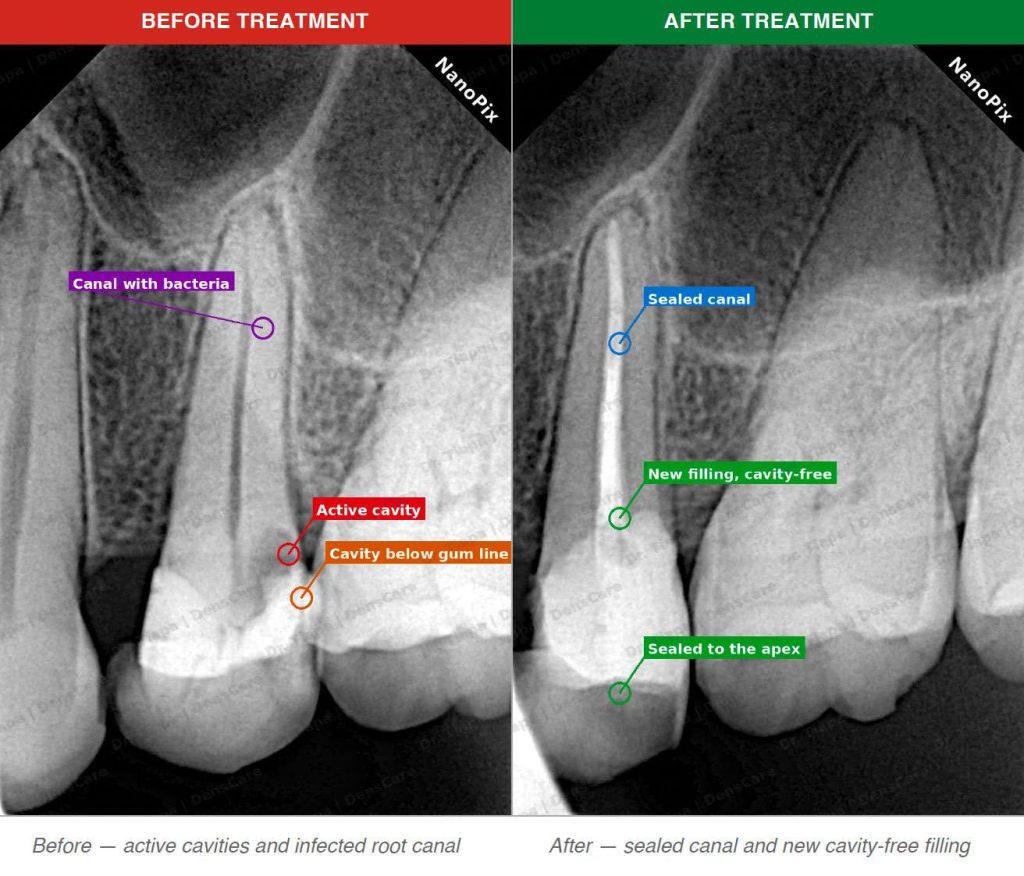
The left image shows the areas of decay and the dark line of the infected canal inside the root. The right image shows the canal completely sealed from top to bottom, with new filling material closing the access point.
4. When the infection has gone further
Case 2 — Advanced abscess with bone involvement
Not all patients arrive when the pain has just started. In many cases, the infection has been progressing silently for months or even years. This is exactly what the second case revealed: a patient who came to DensCare at Hospital CIMA Escazu with a very visible swelling in the gum — an abscess that had broken through to the surface — and pain that was already affecting her daily life.
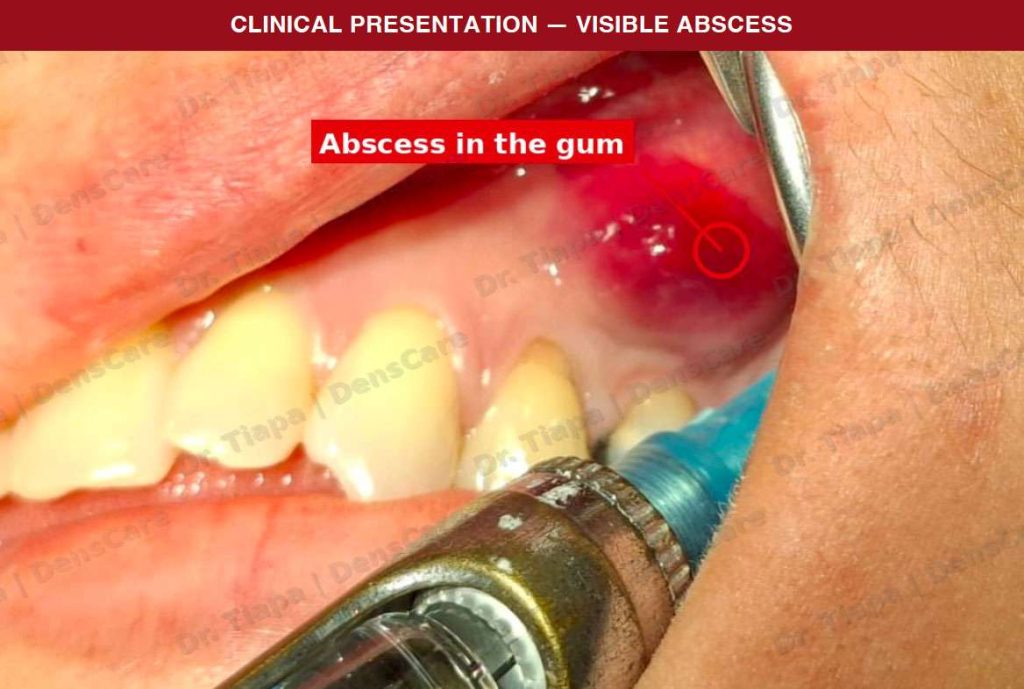
Clinical image — visible abscess in the gum at the time of the emergency
Unlike the first case, the infection here was no longer confined to the inside of the tooth — it had broken through the bone and reached the gum, forming a visible pocket of pus. This is a more severe presentation, and immediate emergency care was essential.
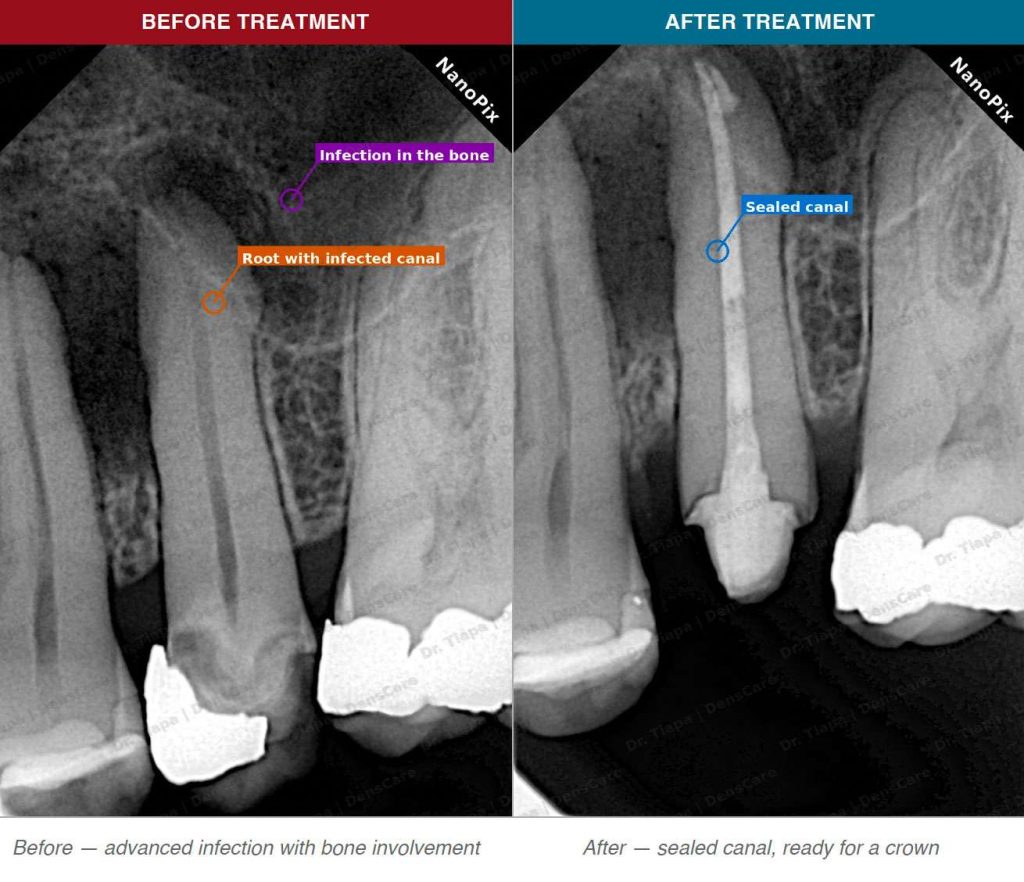
The initial X-ray shows a large dark area in the bone surrounding the root tip — evidence that the infection destroyed bone tissue over many months. The final X-ray shows the canal completely sealed and the tooth ready to receive a protective crown. The bone will gradually regenerate over the next 6 to 18 months.
“The longer a dental infection goes untreated, the more
tissue it destroys. Acting early always makes a difference.”
5. The treatment: step by step, no shortcuts
The endodontist’s goal in both emergencies is the same: remove the infection, clean the inside of the tooth, and seal it so bacteria cannot return. To achieve immediate relief and a lasting solution, there is a sequence that cannot be skipped.
Step 1: Clean and prepare the tooth
All decayed tissue was removed and the tooth was isolated with a rubber dam — a protective sheet that keeps the area completely clean during the procedure. Without this isolation, the treatment cannot be performed to the required sterile standard.
Step 2: Access and shape the root canal
With the tooth isolated and under the operating microscope, a small opening was made to access the inner canal of the root. Precision rotary instruments were used to clean and shape the canal, with the working length measured electronically and confirmed by X-ray.
Step 3: Eliminate the bacteria
The inside of the root was irrigated with a solution that dissolves infected tissue and eliminates bacteria. To ensure the liquid reached every corner, ultrasonic activation was used — tiny vibrations that drive the irrigant into areas that instruments cannot reach.
“Completely eliminating the infection is what ensures the
pain does not return. There are no shortcuts in this step.”
Step 4: Seal the tooth from the inside
With the canal clean, it was filled completely with a specialized material that adapts to the exact shape of the root interior, sealing it from top to bottom so bacteria cannot re-enter.
Step 5: Close the tooth from the outside
The top of the tooth was rebuilt with composite resin, closing the access point until a permanent crown is placed to protect it long-term.
6. The most common dental emergencies in Costa Rica
These two cases represent the most common urgent situations we treat as endodontists in Costa Rica. The following conditions require immediate emergency care:
- Abscess infection. Strong, constant pain with or without visible facial swelling. May be accompanied by fever. Requires same-day treatment.
- Irreversibly inflamed pulp. Sharp pain from cold or heat that does not go away quickly. The pulp is too inflamed to recover on its own.
- Fractured tooth with exposed nerve. A blow, a fall, or biting something hard can crack the tooth down to the nerve. Pain is immediate and infection risk is high.
- Knocked-out tooth. Reimplanted within the first 30 minutes, the chances of saving it are significantly higher.
- Dormant infection that flares up. A tooth with a long-standing silent problem can suddenly become an emergency with intense pain and swelling.
7. When to seek immediate care — and when can it wait?
Seek care today
Can wait 1–2 days
Strong, constant pain that won’t go away
Mild cold sensitivity that passes quickly
Visible swelling in face or neck
Pain when biting with no swelling
Fever combined with tooth pain
Broken crown or filling with no pain
Tooth knocked completely out of mouth
Mild discomfort days after a procedure
Difficulty opening mouth or swallowing
Irritated gum with no pus or swelling
Seek care today
Strong, constant pain that won’t go away
Visible swelling in face or neck
Fever combined with tooth pain
Tooth knocked completely out of mouth
Difficulty opening mouth or swallowing
Can wait 1–2 days
Mild cold sensitivity that passes quickly
Pain when biting with no swelling
Broken crown or filling with no pain
Mild discomfort days after a procedure
Irritated gum with no pus or swelling
8. After the emergency: what comes next
Resolving the emergency is the first chapter, not the last. For the tooth to last long-term, the follow-up care plan is just as important:
- A permanent crown — A tooth that has been treated from the inside needs a full protective covering on top. Without it, the tooth is at high risk of fracture.
- Periodontal evaluation for advanced cases — When the infection has reached the bone, follow-up with a gum specialist may be necessary to support healing.
- A 6-month radiographic check-up — To confirm the bone is healing and the treatment is holding.
Root canal treatment saves the tooth. But the tooth only lasts if the full chain of care is completed: internal treatment, external protection, and periodic check-ups.
9. What these cases teach us
Two different patients. Two different stages of the same disease. Both came to DensCare at Hospital CIMA Escazu seeking immediate relief — and both found it. That is what a well-managed dental emergency should deliver: not just pain relief, but a clear path forward and the real possibility of keeping the tooth.
“A dental emergency treated in time is not just the end of the
pain. It is the beginning of the tooth’s recovery.”
As endodontists specialized in Costa Rica, we know that behind every urgent case lies weeks or months of silent damage. That is why the protocol never changes: operating microscope, precision instrumentation, deep disinfection, complete sealing. No shortcuts. With the conviction that every tooth deserves the chance to stay.


