
How We Work at DensCare, Specialized Endodontics, Hospital CIMA Escazú
DIRECT ANSWER
Is it possible to have a completely pain-free root canal appointment? At DensCare, yes. We combine verified local anesthesia before starting any step, a surgical operating microscope for maximum precision, and constant communication with every patient throughout the procedure. If at any point you feel the slightest discomfort, we stop and reinforce the anesthesia before continuing. That is our guarantee, and it is how we work every day at our specialized endodontic practice in Hospital CIMA, Escazú.
1. WHY DOES ROOT CANAL TREATMENT HAVE A PAINFUL REPUTATION?
Few phrases cause as much anxiety in a dental office as “you need a root canal.” For decades, endodontics carried a reputation that no longer matches clinical reality. That reputation came from an era when anesthesia techniques were less precise, instruments were manual and less predictable, and diagnosis relied almost entirely on clinical judgment, without magnification or high-resolution imaging. In that context, it was common for a dentist to work almost “blind” inside an extremely narrow root canal, which increased the risk of poorly anesthetized areas and longer, less predictable procedures.
Modern dentistry has completely changed that picture. Today, a well-executed root canal treatment should not hurt during the procedure, and any after-treatment discomfort — when it occurs — is usually mild and manageable with common anti-inflammatories. The difference is not in the nature of the treatment itself, which still has the same clinical goal it always has: eliminating infection or inflammation inside the tooth and preserving it. The difference lies in technology, technique, and above all, in the protocol built around every appointment. At DensCare, that protocol is designed from the ground up around one central idea: no patient should postpone a necessary treatment out of fear of pain.
It is important to separate two things that are often confused: the pain that brings a patient in for treatment, and the pain of the treatment itself. Most people who need a root canal arrive with pre-existing discomfort, caused by infection or inflammation in the tooth — not by the procedure they are about to receive. That initial pain is precisely what the treatment is designed to resolve. When we explain this distinction clearly from the first visit, many patients realize that fearing the treatment is, in reality, fearing what already brought them into the office — and that postponing it only prolongs the very discomfort they are trying to eliminate.
2. HOW WE GUARANTEE A PAIN-FREE APPOINTMENT AT DENSCARE
Guaranteeing a pain-free appointment is not a marketing line: it is the result of five concrete clinical decisions we apply at every visit, from the first time a patient sits in the chair to the follow-up call days later.
Honest diagnosis from the first visit
Before touching a single instrument, we clearly explain what is happening with the tooth, why the treatment is recommended, and what the patient will feel at each stage. A patient who understands the process — and trusts that they are being told the truth about their diagnosis — arrives in the chair with far less muscle tension and anticipatory anxiety, two factors that on their own amplify the perception of pain. We do not promise what we cannot deliver, nor do we minimize real discomfort: we explain exactly what to expect, including the sensation of pressure — normal, and very different from pain — that can occur during certain steps of the procedure.
Verified local anesthesia before starting
We use local anesthesia techniques tailored to each tooth and each patient, including supplemental blocks when anatomy or active inflammation requires them. We never begin treatment without confirming, through objective testing, that the area is fully numb. If a patient reports any sensitivity, we apply additional anesthesia before continuing: we would rather pause for two minutes than risk an uncomfortable appointment. This active verification — instead of assuming the anesthesia “should already be working” — is one of the reasons we can offer a real guarantee of a pain-free appointment, not just a reasonable expectation.
Operating microscope: precision that reduces trauma
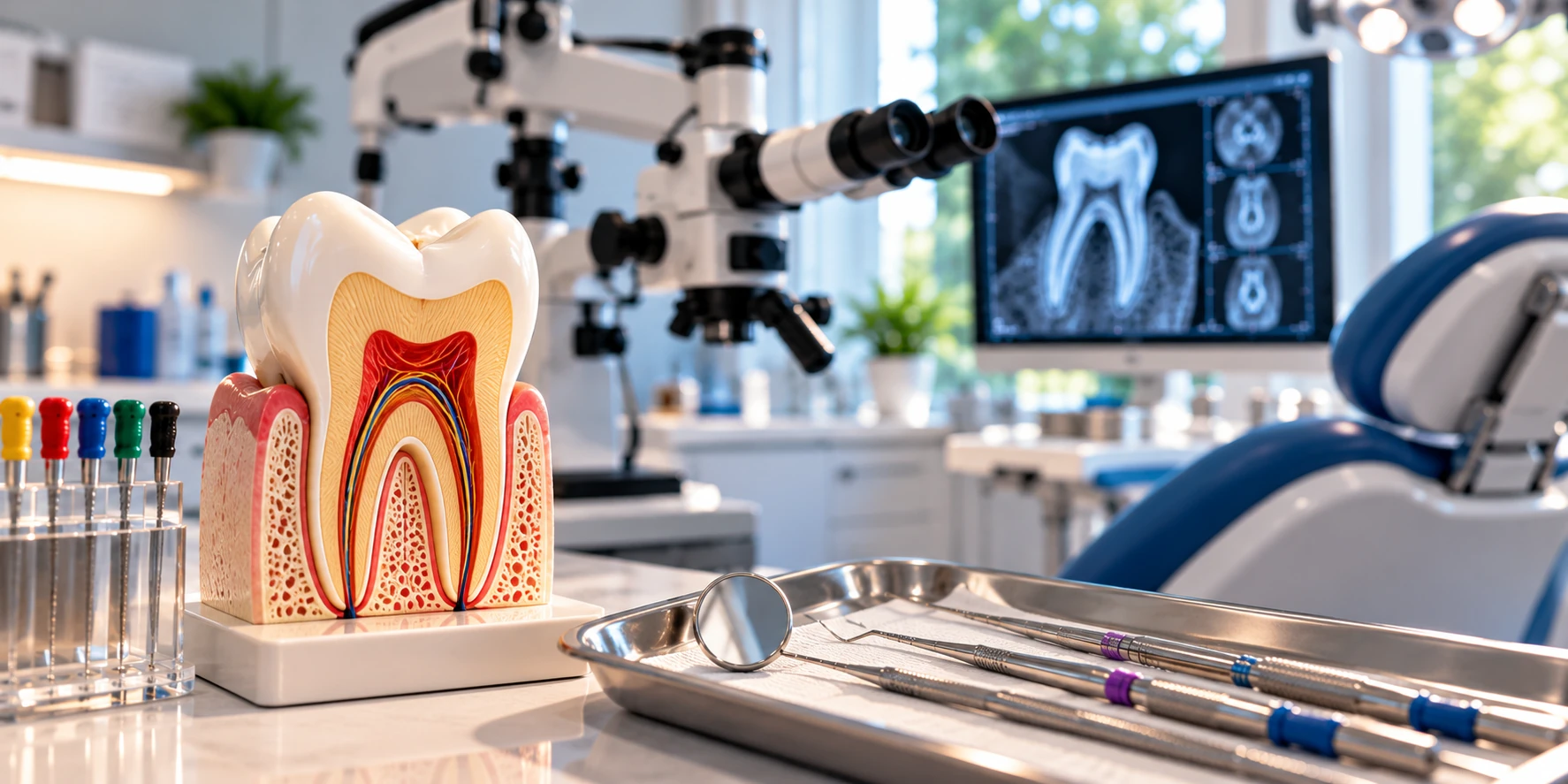
Every treatment at DensCare is performed under a surgical operating microscope, a central technical difference in our practice. The magnification and illumination the microscope provides allow us to locate each root canal with precision, work with more conservative movements, and avoid unnecessary manipulation of healthy tissue around the tooth. Less manipulation means less inflammation afterward and, as a result, less discomfort in the days following treatment. The microscope also shortens the overall length of the appointment, since it eliminates much of the trial and error that occurs when a procedure is performed without magnification.
Actively managing dental anxiety
Fear of the dentist is one of the main reasons people delay treatment until the pain becomes unbearable. At DensCare we actively work to reduce that anxiety: we explain every step before performing it, maintain constant communication during the procedure through a simple signal the patient can use at any time to request a pause, and we care for the environment of the office so it feels calm and predictable. A patient who feels heard and in control of the situation experiences significantly less tension — and muscle tension is, clinically, one of the factors that most intensifies the perception of pain during a dental procedure.
Structured follow-up after treatment
Our guarantee does not end when the patient leaves the office. After every root canal treatment, we follow up actively to confirm that recovery is progressing as expected and to resolve any questions before they become a concern. If unexpected discomfort appears, we have an emergency line available to address it without delay. This structured follow-up — not just the appointment itself — is part of what we mean by “a pain-free experience”: it covers before, during, and after treatment, not only the minutes the patient spends in the chair.
3. FREQUENTLY ASKED QUESTIONS
Does a root canal hurt at DensCare?
No. At DensCare it does not hurt — no pain and no pressure, at any point during the procedure. We work under verified local anesthesia before starting any step, and if a patient feels anything at all, we stop immediately to reinforce it. That is our guarantee, not an expectation.
What happens if I feel pain during the appointment?
You let your dentist know immediately using a simple signal agreed on at the start of the appointment, and the procedure pauses until the anesthesia is reinforced. We never continue a step if the patient reports sensitivity: we would rather pause than risk the comfort of the appointment.
Does the operating microscope really reduce pain?
Yes, indirectly but measurably. Magnification allows for greater precision and less manipulation of the tissue around the tooth, which reduces inflammation afterward and, with it, discomfort in the days following treatment.
How long does the anesthesia last after the appointment?
Generally between two and four hours, depending on the technique used and the individual patient. During that time, we recommend avoiding chewing on the treated side until normal sensation has fully returned, to prevent accidentally biting your lip or cheek.
What should I do after treatment to avoid discomfort?
Follow the specific instructions we give you at the end of the appointment, take the recommended anti-inflammatory if prescribed, and avoid chewing hard foods on the treated side for the first few days. If any unexpected discomfort appears, our emergency line is available.
Have an appointment you've been putting off?
Postponing a root canal out of fear of pain almost always leads to more pain, not less: an untreated dental infection progresses, bringing more discomfort and a greater risk of losing the tooth. At DensCare — Specialized Endodontics, located in Hospital CIMA, Escazú, we have designed every part of the clinical experience around one simple idea: you can receive the treatment your tooth needs without fear of pain. We work with patients referred by other dentists, patients seeking a second opinion on a previous diagnosis, and patients who have simply avoided the dentist for years after a bad experience. In every case, the starting point is the same: listen first, explain honestly, and only then recommend a treatment plan. If you have an appointment you’ve been putting off, write to us or call the office; we are glad to answer your questions before scheduling any procedure.
Phone: 2208-8203 · Emergencies: 7140-0509 · samirtiapa @ samirtiapadenscare.com