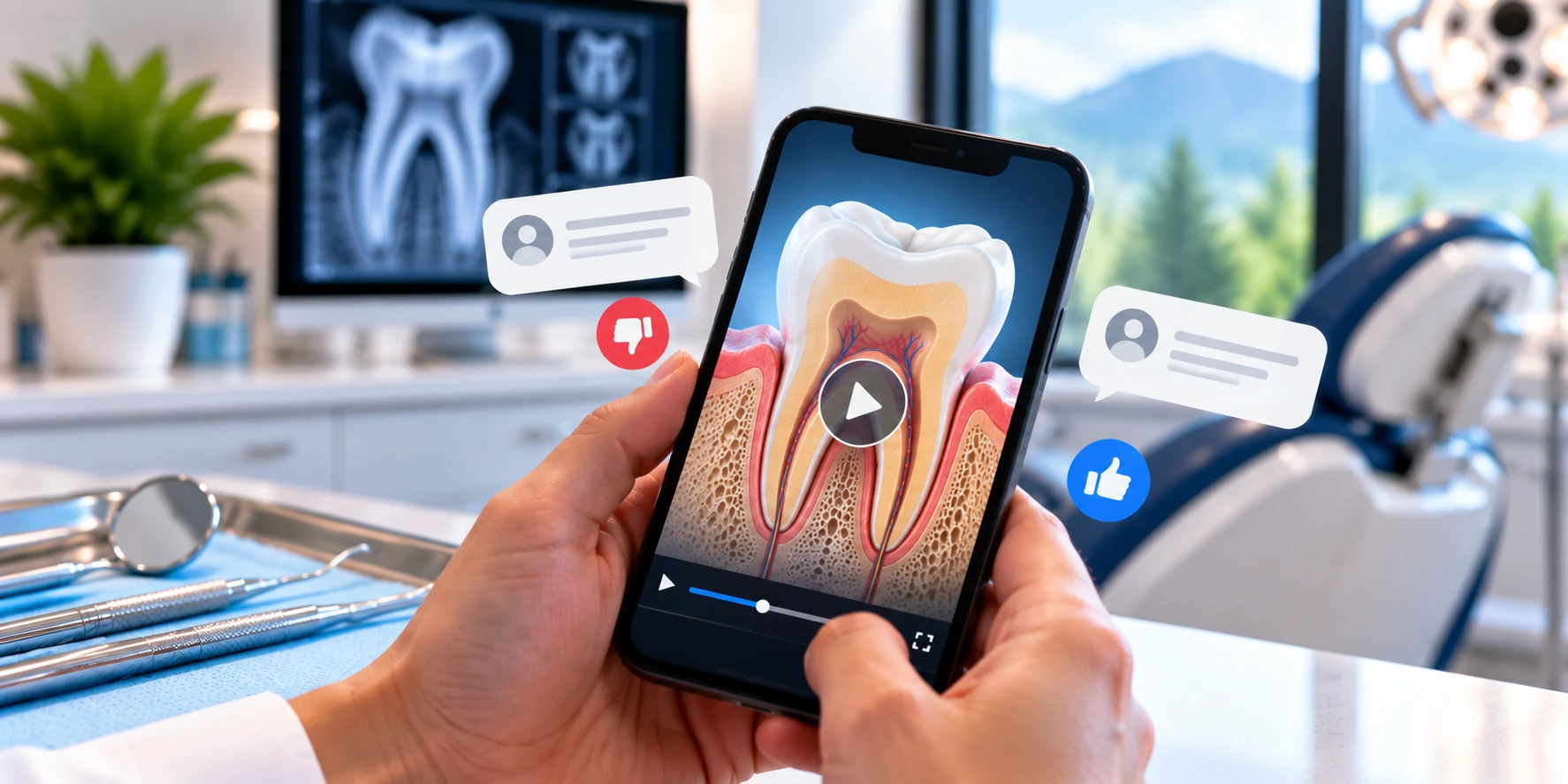
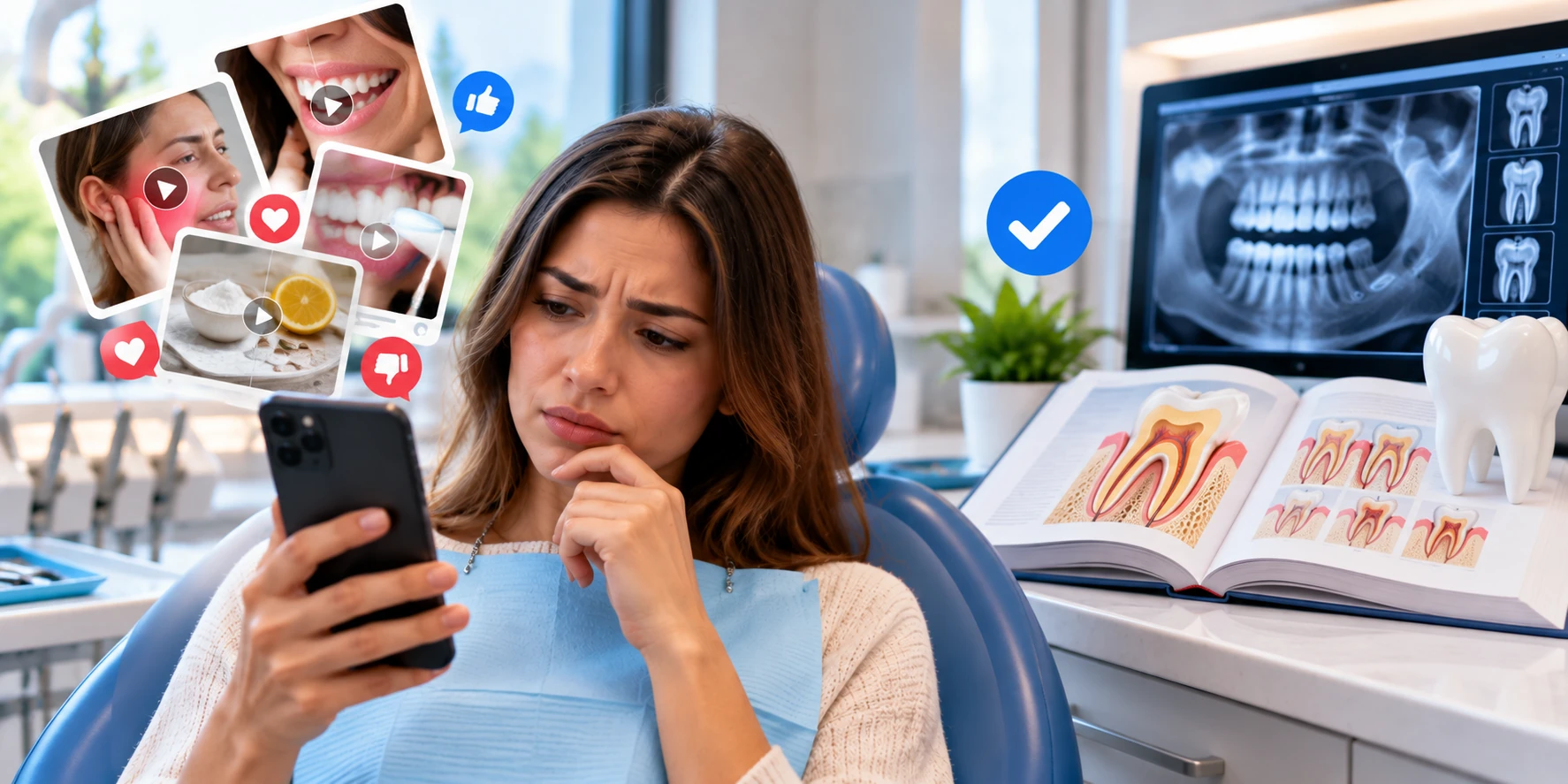
It’s increasingly common for a patient to arrive with a TikTok or Instagram video in hand: “I saw that root canals are dangerous,” or “they say it’s better to just extract and place an implant.” This isn’t a judgment on anyone who shares that content — it reflects a broader reality in modern dentistry: science needs years to build evidence; social media needs only seconds to build an opinion.
At DensCare, we believe an informed patient makes better decisions. So we want to explain, in simple terms, why a popular video isn’t the same thing as clinical truth — and what questions are worth asking before making an irreversible decision about a tooth.
When fear is disguised as information
A few years ago, a documentary called “Root Cause” questioned the safety of root canal treatment on one of the world’s largest streaming platforms. Its arguments revived ideas from the so-called “focal infection theory,” a hypothesis from the early twentieth century that was largely disproven by modern scientific evidence, but that periodically resurfaces under new terminology. The American Association of Endodontists, together with the American Dental Association, issued a public letter pointing out the documentary’s inaccuracies.
The problem isn’t new, but social media accelerates it. Its algorithms don’t distinguish the quality of evidence — they reward content that generates engagement, and fear generates a lot of engagement. An individual opinion, an isolated case, or a claim taken out of context can go viral and appear more credible than decades of accumulated research, simply because of how many likes it receives.
Myth vs. evidence
Some of the claims that circulate most often on social media, compared with what current scientific evidence actually supports:
| What social media says | What the evidence supports |
|---|---|
| “Root canals trap bacteria that make your whole body sick” | The pathophysiology of endodontic infection is well described; there is no solid scientific evidence showing a causal link between a properly treated root canal and systemic disease. |
| “It’s more biological to extract and replace with an implant” | Preserving the natural tooth, when viable, remains the first option according to the evidence — an implant is an excellent alternative when a tooth can no longer be saved, not a default superior choice. |
| “When in doubt, better to just pull it” | Extraction is an irreversible decision. A proper diagnosis, under a microscope and with a second opinion if needed, almost always allows for a more informed decision than acting out of fear. |
| “If the video has millions of views, it must be true” | Algorithms reward content that generates the most reaction, not content best supported by science. Popularity and evidence are not the same thing. |
Our commitment at DensCare
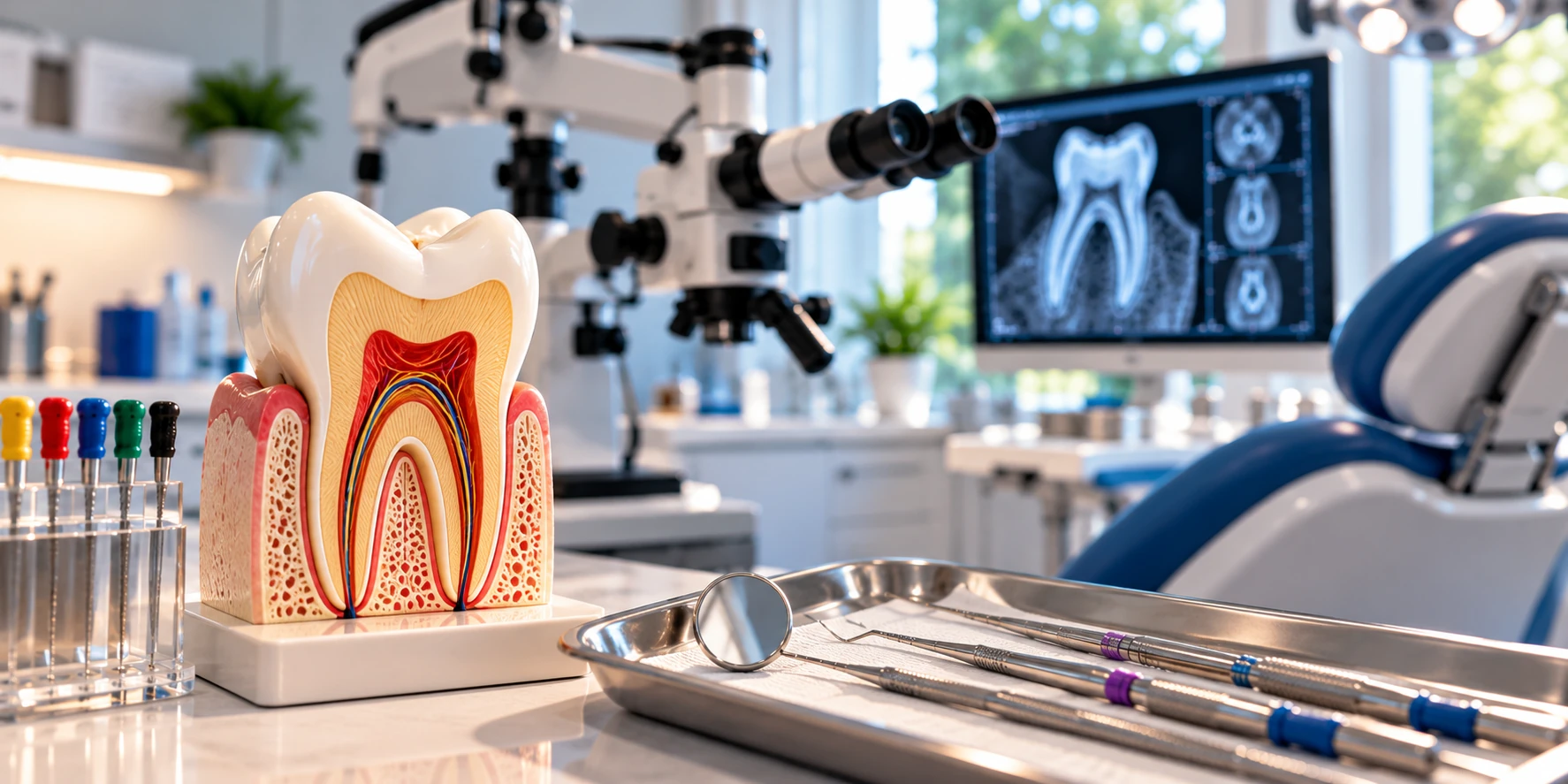
At DensCare, every diagnosis is based on evidence, not trends. We work under an operating microscope on every procedure, provide structured follow-up for every treatment, and explain the available options honestly — including when a tooth can genuinely be preserved and when another recommendation is best. Our goal isn’t the most-viewed tooth on social media; it’s the correctly treated tooth, with the patient’s health at the center of every decision.
Frequently asked questions
Is it true that root canals cause cancer or other diseases?
No. This claim stems from the focal infection theory, proposed over a hundred years ago and discredited by decades of subsequent research. There is no current scientific evidence establishing that causal relationship.
Why do I see so many videos claiming otherwise?
Because social media algorithms reward attention-grabbing content, not the best-supported science. An alarming message generates more engagement than a nuanced technical explanation.
How do I know if my tooth really needs to be extracted?
Through a clinical and radiographic diagnosis by a specialist, ideally under an operating microscope, evaluating case by case whether the tooth can be preserved.
Can I ask for a second opinion before deciding?
Of course. Before any irreversible decision, a second opinion is a responsible and recommended practice — not a sign of distrust in your dentist.
Modern dentistry gives us extraordinary tools — from operating microscopes to instantly accessible scientific databases. The challenge isn’t accessing information; it’s knowing which of it is actually backed by evidence. At DensCare, we’re here to help you work through that question, case by case, with the health of your tooth as the priority.
DensCare · Specialized Endodontics — Dr. Samir Tiapa, Prof. Code 572617
Torre Médica 2, Piso 2, Oficina 203, Hospital CIMA Escazú, Costa Rica · Tel. 2208-8203 · Emergencies 7140-0509
Member of the Academia Costarricense de Endodoncia