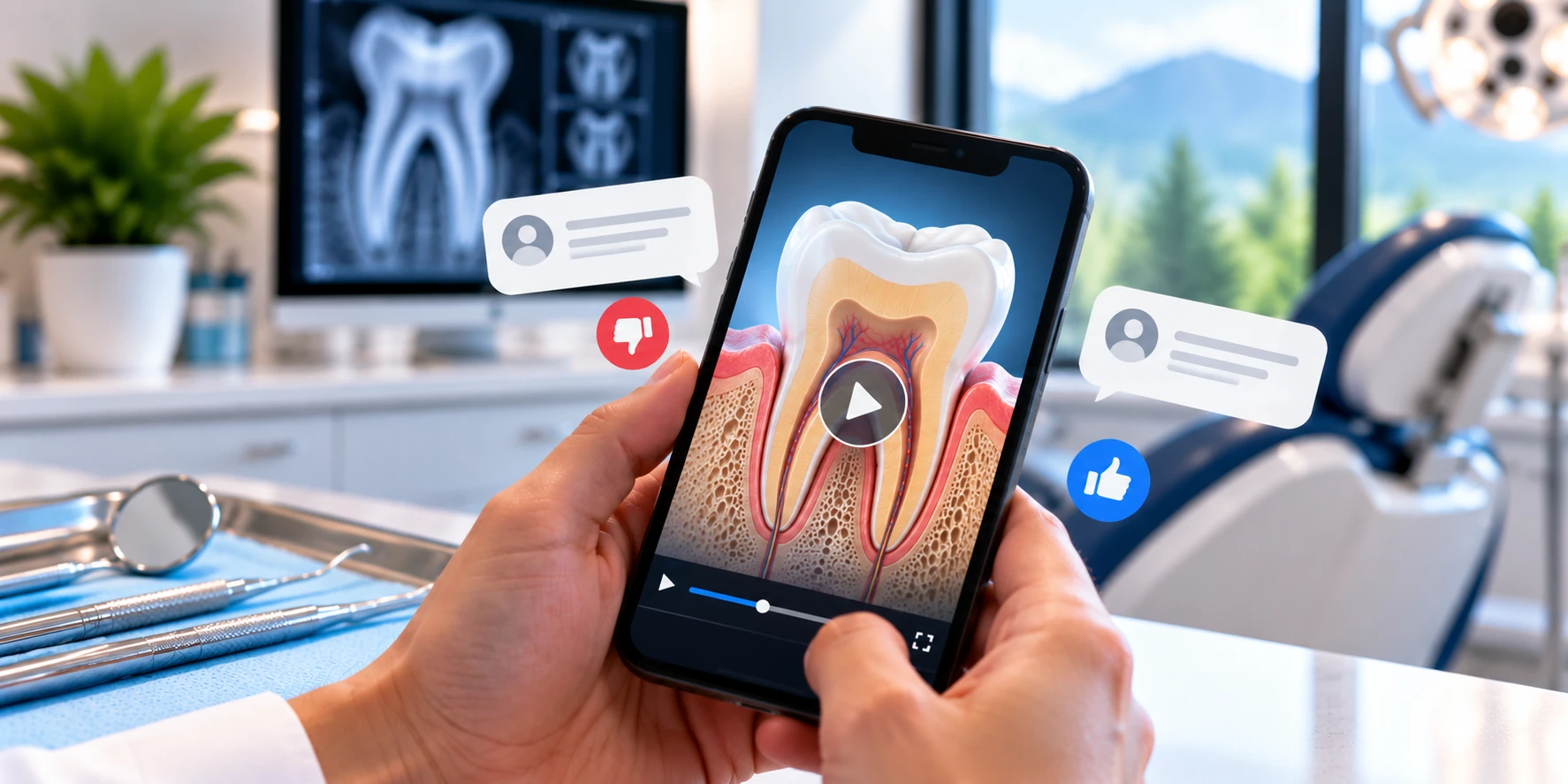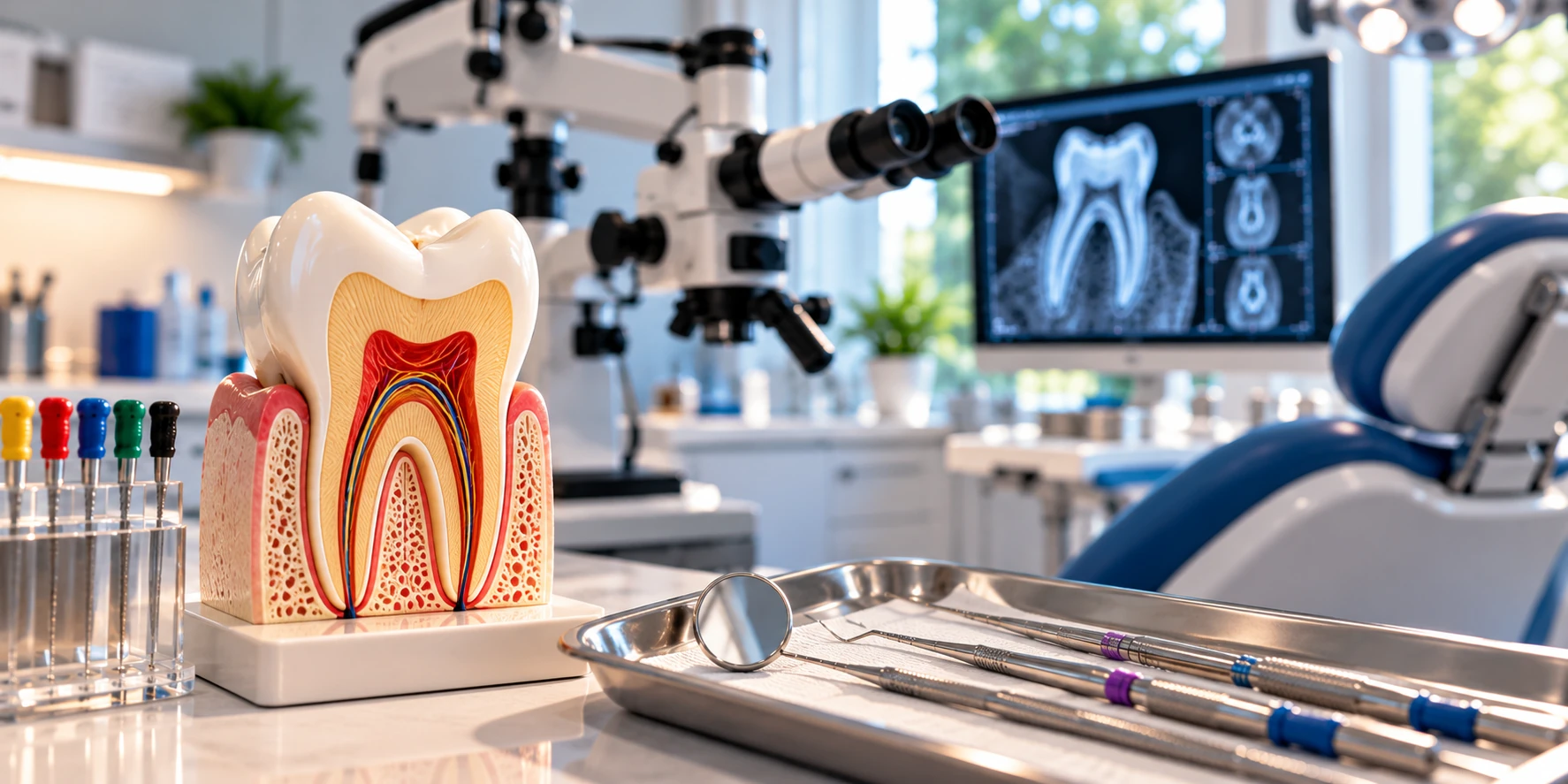

Root canal treatment doesn’t end when the patient gets up from the chair. It ends months, sometimes years, later, when a follow-up X-ray confirms that the bone around the root has fully healed. Between those two moments lies a biological process that can only be evaluated over time, and that’s exactly why, at DensCare, Hospital CIMA Escazú, no treatment is considered finished without a structured follow-up plan. This isn’t an administrative formality — it’s the only real way to confirm that a treatment actually worked. Just as a root canal should never be performed without an operating microscope, it shouldn’t be considered complete without a follow-up plan that confirms, with objective evidence, that the tooth actually healed.
1. WHAT IS POST-TREATMENT FOLLOW-UP IN ENDODONTICS?
It’s a series of control appointments, scheduled at defined intervals, in which the endodontist evaluates — both clinically and radiographically — how the treated tooth is progressing. Every follow-up visit checks three things: whether there are symptoms (sensitivity, pain, swelling), whether the tissues around the tooth are healthy, and whether the lesion that originally surrounded the root — when one was present — is shrinking on the X-ray. None of these three on its own is enough: a tooth can feel perfectly fine and still have an active infection that only the X-ray reveals.
2. WHY DOESN'T THE ABSENCE OF PAIN MEAN SUCCESS?
As we explained in our article on the operating microscope, many endodontic complications stay silent for months or years before showing up. A low-grade infection around the root doesn’t always cause pain, especially if the patient’s immune system keeps it temporarily under control. Relying only on the absence of symptoms to decide a treatment was successful is, simply put, working with incomplete information. The only way to know for certain that a canal healed is by comparing X-rays taken at different points in time and confirming that the bone is regenerating progressively. This isn’t unique to complex cases: even a treatment performed under an operating microscope, with the most precise technique available, still depends on each patient’s individual biological response to heal — and that response can only be observed over time, never on the same day as the procedure.
3. WHEN SHOULD THE FIRST FOLLOW-UP HAPPEN, AND WHY?
The endodontic literature generally agrees that six months is a reasonable early checkpoint for most cases. At that point, if a periapical lesion was present before treatment, it should already appear smaller on the X-ray — a sign that healing is progressing correctly. If the lesion is still present but reduced in size, that’s not a cause for alarm; it simply means healing is ongoing and another follow-up is needed further down the line.
4. THE CRITICAL YEAR: WHAT THE TWELVE-MONTH FOLLOW-UP REVEALS
Based on the available evidence, this is the single most important decision point in the entire follow-up process. If, at twelve months, a periapical lesion remains unchanged or has grown, it is very unlikely to resolve on its own, and that finding is considered a failure of the original treatment. At that point, the clinical approach shifts: retreatment, periapical microsurgery, or — in a fortunately small percentage of cases — extraction all become options worth evaluating. Without that twelve-month check, this decision window is simply missed, and the tooth can spend years quietly deteriorating without anyone noticing until obvious symptoms finally appear. One prospective study that followed patients for twenty-four months found that 89% of treated teeth showed a favorable outcome at that point, but it also confirmed that a meaningful share of cases only showed clear signs of improvement, or of failure, after the first year — not before. That’s exactly why a single check done a few weeks after treatment is no substitute for follow-up scheduled over the medium term.
5. HEALING KEEPS GOING: FOLLOW-UP OUT TO FOUR YEARS
Prospective studies show that bone healing around the root can keep progressing well into the second year after treatment, and that larger periapical lesions naturally take longer to resolve than smaller ones. Long-term meta-analyses report the following pooled success rates by elapsed time:
Follow-up point | Expected finding | What it means |
6 months | Lesion absent or smaller | Healing in progress |
12 months | Unchanged or larger lesion | Likely failure — evaluate retreatment |
2 – 4 years | ~90% pooled success | Long-term success confirmed |
4 – 6 years | ~93% pooled success | Outcome stability |
In other words, declaring a treatment “successful” just weeks after it’s finished is, clinically speaking, premature. The real outcome becomes clear over time — not at the appointment where the temporary crown comes off. Larger lesions, in particular, need this extra runway: a small periapical lesion may resolve within the first year, while a larger one can still be visibly shrinking, and legitimately healing, well past that point.
6. WHAT HAPPENS IF A PATIENT SKIPS FOLLOW-UP?
The most common consequence isn’t immediately dramatic — and that’s exactly the trap. A treatment that is quietly failing continues to let residual bacteria slowly reactivate, without the patient noticing, until pain, swelling, or a gum boil eventually shows up. By then, what could have been a simple, early adjustment — starting retreatment before the lesion grew, for example — has turned into a more complex case, with a larger lesion, more compromised bone, and a less certain prognosis. Follow-up doesn’t prevent every complication, but it does determine how early problems are caught and how simple they are to fix. This is true even for teeth that were treated flawlessly at the time: no technique, however precise, can guarantee how an individual patient’s bone will respond, which is exactly why the follow-up appointment — not the treatment appointment — is where a truly failing case gets caught while it’s still simple to manage.
7. HOW DENSCARE HANDLES FOLLOW-UP
Every treatment performed at Torre Médica 2, Hospital CIMA Escazú, comes with an individualized follow-up plan based on the specific case: most patients are scheduled for a check at six months and another at one year, while cases with larger periapical lesions or more complex anatomy are followed for up to two years. Each visit includes a clinical exam, a comparative X-ray, and, when relevant, clinical photographs — all documented in the patient’s chart so progress can be objectively compared, tooth by tooth, over time. Patients who underwent retreatment, periapical microsurgery, or who presented with a larger periapical lesion at diagnosis receive a closer follow-up schedule, precisely because these are the cases where the twelve-month decision point carries the most clinical weight. The same standard of precision that the operating microscope demands during treatment — seeing exactly what exists inside the tooth — applies afterward too: verifying exactly how that same tooth is healing, visit after visit.
8. FREQUENTLY ASKED QUESTIONS
Here are some of the questions patients ask most often about follow-up appointments after root canal treatment.
How long does a follow-up appointment take?
Usually 15–20 minutes: a brief clinical exam plus a comparative X-ray checked against the original treatment images.
What if I feel fine and skip my follow-up?
The tooth could be healing, or have an active symptom-free infection; without the X-ray there’s no way to tell in time.
How many follow-up visits do I need?
Most patients need at least two: at six months and at one year. Larger lesions may need follow-up out to two years.
If follow-up shows it didn't heal, what are my options?
Nonsurgical retreatment, periapical microsurgery, or in advanced cases, extraction. Catching it early keeps more options open.
A root canal treatment without follow-up is a treatment whose outcome was never confirmed. At DensCare, Hospital CIMA Escazú, every treatment includes a follow-up plan designed to verify, with comparative X-rays, that healing is progressing as it should.