
A guide from DensCare · Specialized Endodontics, Hospital CIMA Escazú, on why extraction deserves a specialist’s evaluation before you decide.
When a tooth hurts, becomes infected, or shows up fractured on an X-ray, the fastest recommendation — and often the most repeated one — is to extract it. Yet modern dentistry now has diagnostic and treatment tools, such as the operating microscope and volumetric tomography, that can save teeth that would have been lost just a decade ago. Before signing the consent form for an extraction, getting a second opinion from an endodontist — the specialist specifically trained to diagnose and treat the inside of the tooth — can be the difference between losing a tooth permanently and keeping it functional for many more years.
1. A tooth that looks lost can almost always be evaluated
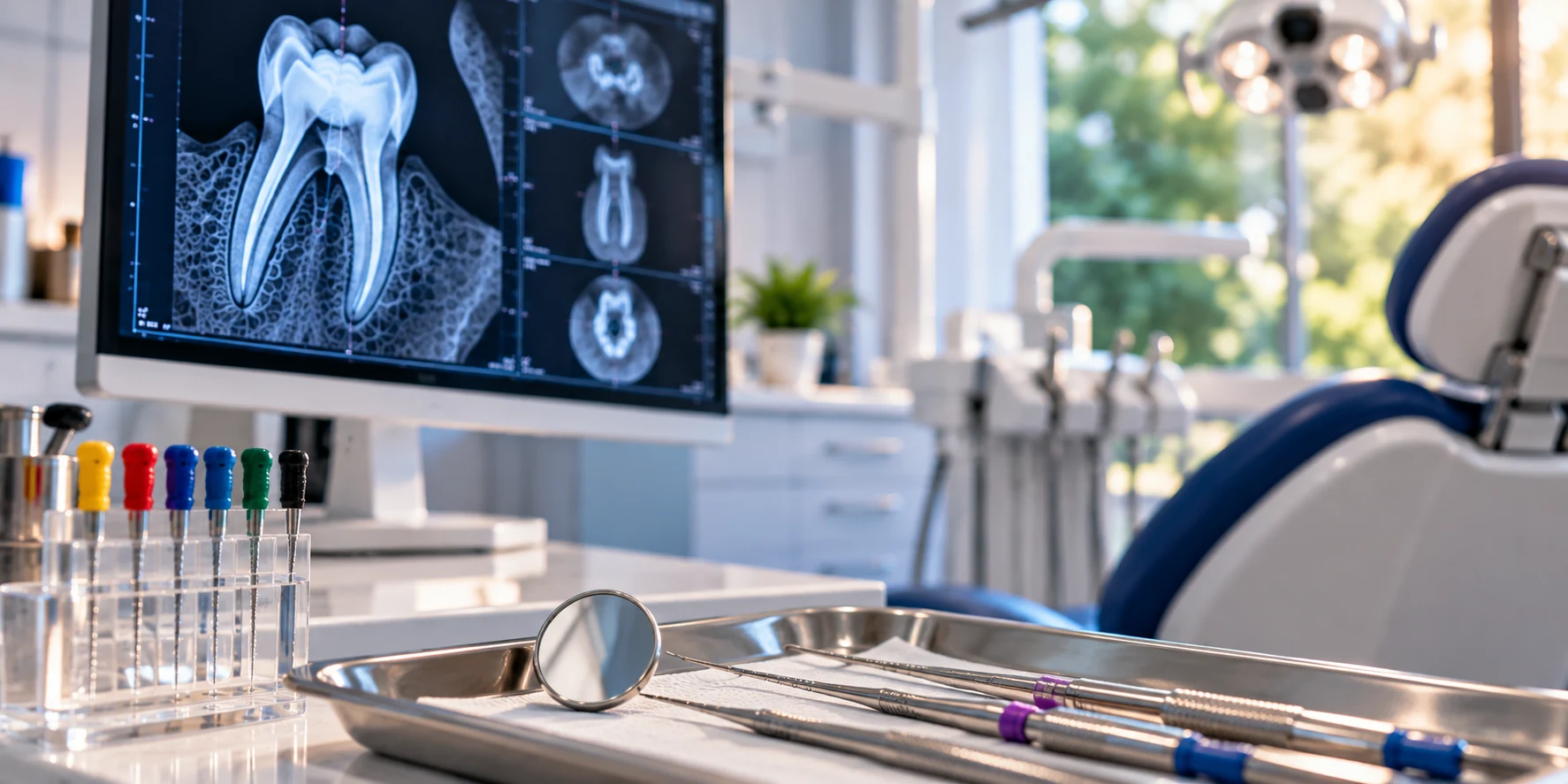
Most extractions recommended for pain, infection, or fracture are decided based on a conventional periapical X-ray and a visual review in two dimensions of a structure that is, in reality, three-dimensional. An endodontist evaluates the same tooth under an operating microscope, which magnifies the field of view 8 to 25 times, and with tomography when the case calls for it. That difference in resolution is what allows additional canals, partial fractures, or the true source of an infection to be identified — details that, to the naked eye, appeared to seal the tooth’s fate for extraction.
In our practice we see the same pattern often: a patient arrives with an instruction to “just pull it,” and after a specialized evaluation under the microscope, the tooth turns out to be perfectly treatable with retreatment or a minor endodontic surgical procedure. It’s not that the first opinion was given in bad faith — it’s that precise endodontic diagnosis requires equipment and training that not every general practice has on hand.
This is especially true in cases that look simple at first glance, such as a molar that hurts when chewing. That symptom can originate from a deep but treatable cavity, an incipient crack that hasn’t yet compromised the whole root, or an infection that responds well to retreatment. Without an evaluation that distinguishes between these causes, it’s easy for extraction to become the default answer simply because it’s the fastest one to carry out, not because it’s the only viable option.
2. When extraction really is the right call
Getting a second opinion doesn’t mean refusing extraction at all costs. There are situations — a complete vertical root fracture, advanced external root resorption, severe bone-support loss, or a tooth without enough remaining structure to be restored — where extraction remains the most responsible choice, even for an endodontist. The difference is that this conclusion is reached only after actively ruling out the alternatives, rather than as the first reflex in response to pain.
Extraction vs. root canal treatment: a direct comparison
| Aspect | Extraction | Root canal treatment (endodontics) |
|---|---|---|
| Chewing function | Lost in that area unless replaced with an implant or bridge | The natural tooth and its original function are preserved |
| Total long-term cost | Extraction plus implant or bridge usually cost more combined | Generally lower than replacing the tooth with an implant |
| Bone around the tooth | Begins to resorb after the tooth is lost | Preserved, since the natural root keeps stimulating the bone |
| Treatment time | Extraction is fast, but the later replacement takes months | Usually completed in one or two visits |
| Neighboring teeth | May shift toward the empty space over time | Not affected; the tooth stays in its original position |
3. What a second opinion from an endodontist specifically adds
Not every second opinion adds the same value. Consulting another general dentist may confirm the same diagnosis if the same tools are used. The real value of seeing an endodontist is access to a different level of diagnosis: at DensCare, every treatment and every tooth-preservation evaluation is performed under an operating microscope, which makes it possible to see curved or calcified canals and incipient fractures that go unnoticed on a conventional exam. Added to that is specific clinical experience: an endodontist evaluates, on average, far more complex tooth-preservation cases per year than a general dental practice does.
An endodontist can also clearly explain the tooth’s real prognosis — not just whether treatment is possible, but what chance of success it has over five or ten years — so that the final decision, whatever it is, is made with complete information rather than under the pressure of the moment’s pain.
This kind of guidance also includes follow-up care afterward: if the tooth is treated, the prognosis is confirmed through clinical and radiographic checkups in the following months, verifying that the infection healed and that the decision to preserve the tooth was, in fact, the right one in the long run.
Something else many patients don’t consider is the impact losing a tooth has on the rest of the mouth. When a tooth is extracted and not replaced right away, neighboring teeth tend to tilt into the empty space, and the opposing tooth — in the jaw or maxilla across from it — can extrude as it seeks contact. That gradual shift alters the entire bite and, months or years later, can lead to wear, jaw joint pain, or the need for additional treatment that would never have been necessary had the original tooth been preserved. So the question shouldn’t only be “can this tooth be extracted?” but “what happens to the rest of my mouth if I extract it?”
What to ask at your second-opinion appointment
- Was the tooth evaluated under an operating microscope, or only with a conventional X-ray?
- Is there a volumetric scan (CBCT) confirming the diagnosis?
- What is the tooth’s real prognosis, expressed as a success percentage?
- What would happen to the neighboring teeth and bone if I choose extraction instead?
- What would the total cost be — extracting and replacing the tooth versus preserving it?
5. Frequently asked questions
Does a second opinion with an endodontist cost extra?
Yes, it’s an evaluation visit like any other clinical appointment, but it usually costs far less than an implant and can prevent a bigger expense if the tooth turns out to be treatable.
How much time do I have to get a second opinion before it's too late?
It depends on the case, but in general you don’t have to decide the same day the pain starts. An infection can often be managed with antibiotics or drainage while the evaluation is completed, except in true emergencies, which the specialist will recognize right away.
Can every infected tooth be saved with root canal treatment?
Not every one, but a high percentage of the teeth recommended for extraction turn out to be treatable once evaluated under an operating microscope with the right diagnosis.
What happens if we ultimately agree that extraction is needed?
Then the extraction is carried out knowing every alternative was explored, and you can plan the replacement (implant or bridge) in time, before the bone starts to resorb.
Does DensCare see second-opinion patients from other practices?
Yes. At DensCare, inside Hospital CIMA Escazú, we see cases referred by other dentists and patients seeking an endodontic evaluation under an operating microscope before deciding on an extraction.
In the end, the decision to preserve or extract a tooth belongs to the patient, but that decision is only truly informed when it’s made with the most complete diagnosis available. A second opinion doesn’t question the first professional’s good intentions; it adds a layer of certainty before a procedure that can’t be undone.
The core recommendation is simple: no tooth should be extracted based on a decision made in a single office and without the right tool to confirm it. Getting a second opinion from an endodontist doesn’t delay treatment — it makes it more precise. At DensCare · Specialized Endodontics, inside Hospital CIMA Escazú, we offer tooth-preservation evaluations under an operating microscope and pain-free root canal treatment, with the goal of helping every patient keep their natural teeth for as long as possible.
Dr. Samir Tiapa — Endodontist, DensCare · Specialized Endodontics
DensCare · Specialized Endodontics — Torre Médica 2, Piso 2, Oficina 203, Hospital CIMA Escazú, Costa Rica
Tel. 2208-8203 · Emergencies 7140-0509 · Member of the Academia Costarricense de Endodoncia


