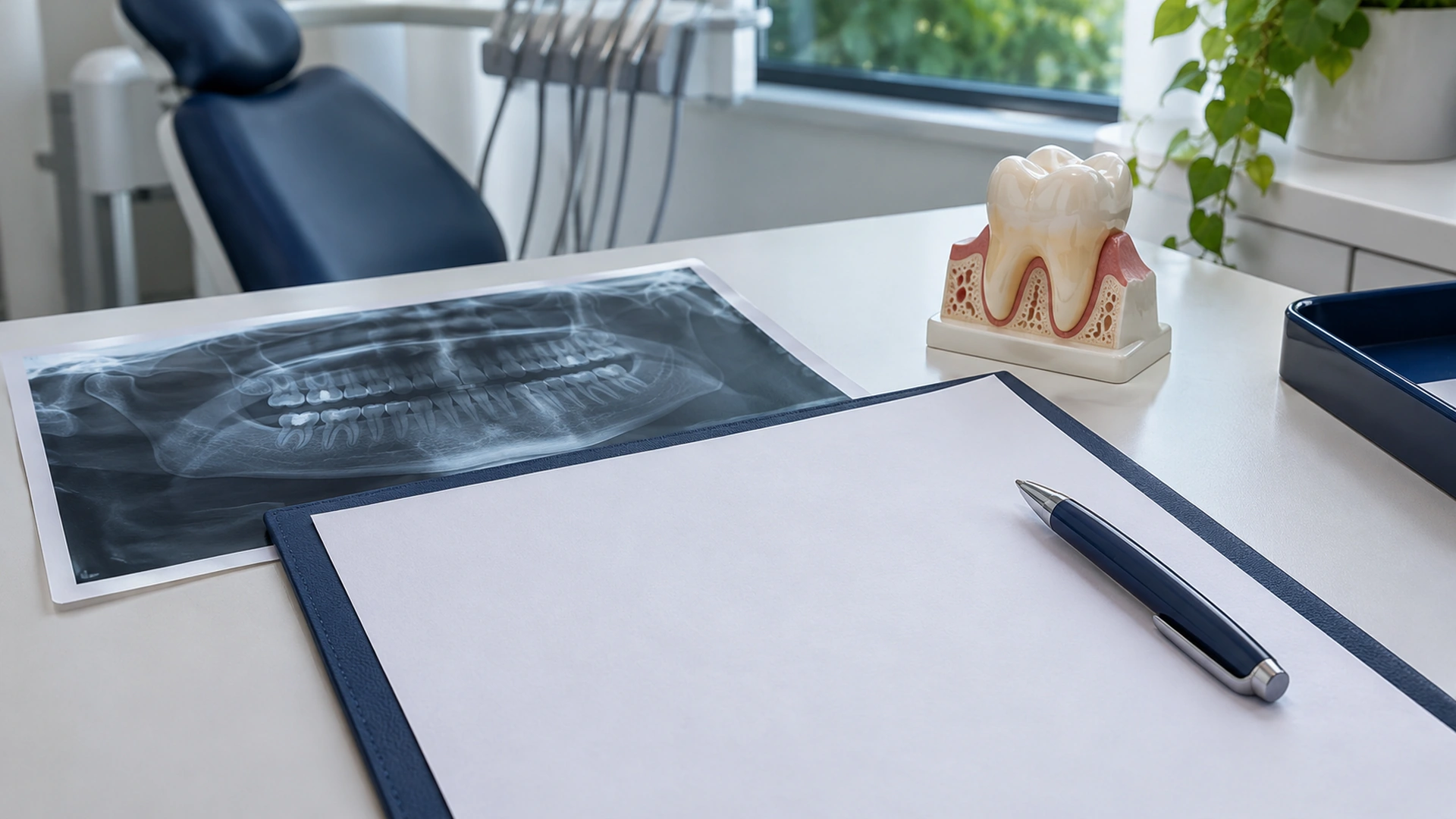
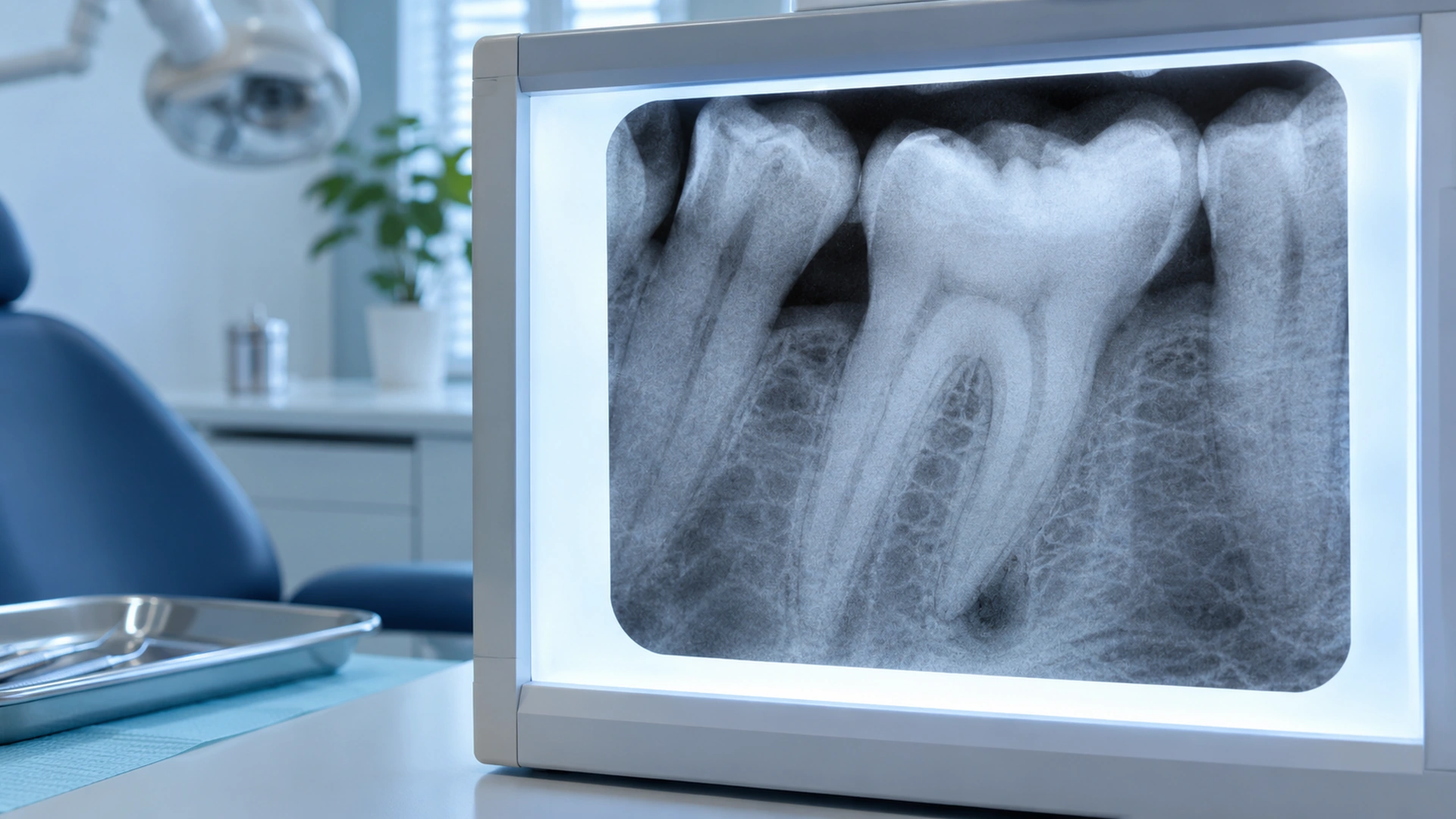
“But doctor, it doesn’t hurt at all.” It is one of the phrases I hear most often in my office. A patient comes in for a cleaning, a routine check-up or a referral from their dentist, and the X-ray shows a dark spot at the tip of the root of a tooth that has never bothered them. The surprise is understandable: all our lives we have learned that pain is the signal that something is wrong.
In endodontics, however, many of the most important infections are completely silent. In this article I explain, in plain language, what that shadow is, why it doesn’t hurt, and why treating it in time protects your tooth, your bone and your health.
1. What is the “shadow” on the X-ray?
Inside every tooth there is a space containing living tissue called the pulp, commonly known as “the nerve.” When deep decay, a crack, a blow or a leaking filling allows bacteria to reach it, the pulp becomes inflamed and, over time, dies. The inside of the canal then becomes a hideout for bacteria: a place with no blood supply, where the body’s defenses cannot reach.
From that hideout, bacteria and their toxins leak out through the tip of the root into the bone. The body responds with inflammation to contain them and, in the process, the bone around the root tip is lost. On an X-ray, healthy bone looks light; the area where bone has been lost appears dark. That is the “shadow.”
Its technical name is apical periodontitis, and it can take the form of a granuloma, a cyst or an abscess. What matters to you is this: the shadow is not a harmless “old mark.” It is an area of bone destroyed by an infection that keeps feeding from inside the tooth.
2. Why can a tooth infection be painless?
There are three main reasons:
- The nerve is no longer alive. Severe toothache almost always happens while the pulp is alive and inflamed. Once it dies, it stops sending signals. Many patients remember strong pain months or years ago that “went away on its own.” It didn’t heal: the nerve died, and the infection carried on in silence.
- The body reaches a stalemate. Your defenses surround the infection and keep it in check, but they cannot eliminate it, because the source is inside the canal, out of their reach. It is like trench warfare: quiet on the outside, active on the inside.
- The infection finds a way out. Sometimes pus drains through a small channel to the gum, called a fistula. Because the pressure is released, there is no pain, even though the infection is still there.
That is why the absence of pain does not mean the absence of disease. It only means that, for now, the disease is quiet. Studies from many countries estimate that roughly half of all adults have at least one tooth with this kind of lesion, and most of them don’t know it.
3. What happens if a silent lesion is left untreated?
A chronic lesion may stay stable for a while, but it does not go away on its own, because the source of bacteria remains inside the tooth. This is the difference between waiting and treating:
| If you wait | If it is treated in time |
|---|---|
| The lesion can grow and destroy more bone. | The bone gradually regenerates. |
| It can turn into an acute abscess with pain and swelling, often at the worst moment: a trip, a weekend. | Treatment is scheduled calmly, with no emergency. |
| The infection can spread to nearby tissues; in upper teeth it can affect the maxillary sinus. | The source of the infection is eliminated. |
| The tooth weakens and may eventually be lost. | Your natural tooth is preserved. |
| Less bone remains if an implant is ever needed. | The bone in the area is preserved. |
| The body keeps a source of chronic inflammation. | The inflammation resolves. |
In rare cases, a spreading dental infection can involve the face or neck and require hospital care. This does not mean that a tooth “causes” disease in other organs —that old idea has been discarded by science— but a basic principle of medicine applies: a chronic infection is not left untreated anywhere in the body, and the mouth is no exception.
4. Subtle signs that may appear
Even without pain, there are sometimes clues. See a specialist if you notice:
- A small “pimple” or bump on the gum that comes and goes, sometimes with a salty or unpleasant taste.
- A tooth that has darkened (grayish or yellowish) compared to its neighbors.
- A feeling that a tooth is “higher,” or mild discomfort when biting hard.
- A tooth that took a blow years ago, even if it never hurt.
- Severe pain in the past that disappeared completely without treatment.
- A tooth with an old root canal treatment or a very large filling.
Often, however, there are no signs at all and the lesion is discovered on a routine X-ray. That is why regular check-ups with your dentist are so valuable.
5. How is it diagnosed correctly?
An accurate diagnosis combines several tools, because a single image does not always tell the whole story:
- Periapical X-ray: shows the root and the surrounding bone. It is the first step.
- 3D cone-beam CT scan: shows the tooth in three dimensions. It detects lesions that can stay hidden on a conventional X-ray and reveals their size and relationship to the maxillary sinus or the nerve.
- Clinical tests: cold sensitivity, response to tapping and pressure, and gum evaluation, to confirm whether the nerve is alive or not.
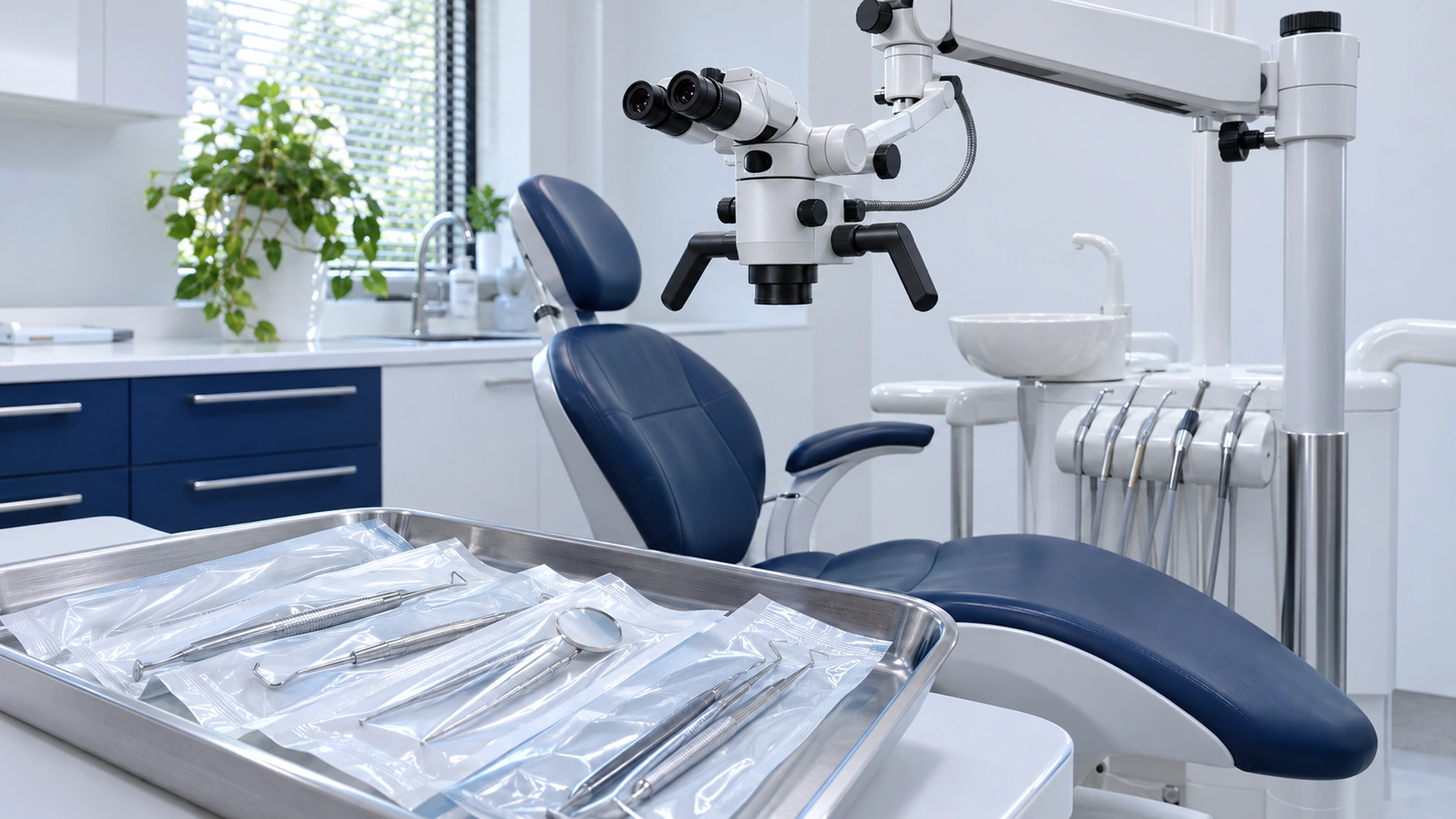
- Examination under the operating microscope: reveals cracks, extra canals or leaks that cannot be seen with the naked eye.
It is also important to know that not every dark area is an infection: some normal bone structures can look similar. Telling them apart is the specialist’s job. At DensCare, at Hospital CIMA Escazú, we show you your own images and explain clearly what we see. If the lesion needs treatment, we tell you; if it doesn’t, we tell you that too.
6. How is it treated, and how long does it take to heal?
The indicated treatment is root canal treatment (endodontics). It consists of removing the bacteria from inside the tooth, thoroughly disinfecting the canals and sealing them so they cannot be recontaminated. Once the source of infection is gone, the body does the rest: the bone begins to regenerate on its own.
At our clinic, every treatment is performed under the operating microscope with proper anesthesia, so the procedure is comfortable and pain-free. If the tooth already had a previous root canal that failed, the solution is usually a retreatment and, in some cases, microsurgery at the tip of the root.
The shadow does not disappear overnight. The bone rebuilds gradually, and healing is confirmed with follow-up X-rays, usually at 6 and 12 months; for large lesions, follow-up may continue longer. The vast majority of lesions heal completely when treatment is done correctly. That is why, at DensCare, every case has a structured follow-up.
7. Frequently asked questions
If it doesn’t hurt, can I wait?
It is not advisable. The lesion can grow, flare up or weaken the tooth. Waiting does not cure it; it only postpones treatment and often makes it more complex.
Do antibiotics cure the lesion?
No. Antibiotics travel through the bloodstream and cannot reach the inside of a canal with a dead nerve. They may calm an acute flare-up, but the infection comes back. Only cleaning the canal removes the source.
Does the shadow go away after treatment?
In the vast majority of cases, yes. The bone regenerates gradually, and this is verified with follow-up X-rays.
Isn’t it better to pull the tooth?
Extraction removes the infection, but also the tooth. When the tooth can be restored, keeping it is usually the healthiest, simplest and most economical option in the long run.
Does root canal treatment hurt?
No. With proper anesthesia, you feel no pain and no pressure during the procedure.
Can a tooth that already had a root canal get infected again?
Yes, if the seal leaks or canals were left untreated. In those cases, a retreatment is evaluated.
If your dentist told you there is a “shadow” on one of your teeth, or a routine X-ray showed a lesion, don’t put it off just because it doesn’t hurt. The disease is there, even if it is silent, and treating it in time is the best way to keep your natural tooth.
At DensCare we provide root canal treatment in Escazú, at Torre Médica 2, Office 203, Hospital CIMA, with honest diagnosis, pain-free treatment under the operating microscope, and follow-up for every case. To schedule your evaluation, call +506 2208-8203.
Dr. Samir Tiapa — Endodontist, Clinical Director of DensCare · Specialized Endodontics